
Few crochet projects feel as special as making a blanket for a new baby. Whether you’re preparing a handmade baby-shower gift, planning a nursery project, or simply looking for a smaller blanket to practice your crochet skills, crochet newborn blanket patterns offer plenty of beautiful possibilities.
And they don’t need to be complicated.
Some of the most attractive newborn blankets are made with simple repeating stitches, soft yarn and carefully chosen colors. Current beginner patterns commonly use one-row or simple repeating constructions because they’re easier to memorize and make larger projects much more approachable.
Below you’ll find 15 newborn blanket ideas, followed by a complete beginner-friendly pattern you can use to make your own.
Crochet Newborn Blanket Patterns at a Glance
| Pattern Idea | Difficulty | Main Style | Best For |
|---|---|---|---|
| Simple HDC Blanket | Beginner | Classic | First blanket |
| Moss Stitch Blanket | Beginner | Modern | Lightweight texture |
| Textured Suzette Blanket | Beginner | Textured | Cozy gifts |
| Granny Stitch Blanket | Beginner | Traditional | Colorful projects |
| Striped Blanket | Beginner | Modern | Gender-neutral gifts |
| Shell Stitch Blanket | Easy | Elegant | Keepsake |
| Ripple Blanket | Easy | Wavy | Color combinations |
| Waffle Stitch Blanket | Intermediate | Thick texture | Cooler weather |
| Color Block Blanket | Beginner | Minimalist | Modern nursery |
| Corner-to-Corner Blanket | Easy | Diagonal | Custom designs |
| Pastel Baby Blanket | Beginner | Soft colors | Nursery décor |
| Neutral Baby Blanket | Beginner | Minimal | Unisex gifts |
| Heart Texture Blanket | Easy | Decorative | Baby showers |
| Granny Square Blanket | Easy | Modular | Scrap yarn |
| One-Row Repeat Blanket | Beginner | Simple | Relaxing crochet |
What Size Should a Newborn Crochet Blanket Be?
There’s no single mandatory size for a handmade newborn blanket.
A 30 × 30 inch (76 × 76 cm) square is commonly used in newborn-focused crochet patterns. For example, Handy Little Me’s current newborn moss-stitch pattern finishes at 30 × 30 inches, while other newborn designs are around 30 × 36 or 35 × 35 inches.
For our beginner pattern later in this guide, we’ll target approximately:
30 × 32 inches
That keeps the project manageable while still creating a useful handmade blanket.
Important: handmade blankets should not be treated as safe-sleep bedding for an unattended sleeping infant. Follow current pediatric safe-sleep guidance when the blanket is intended for a real baby.
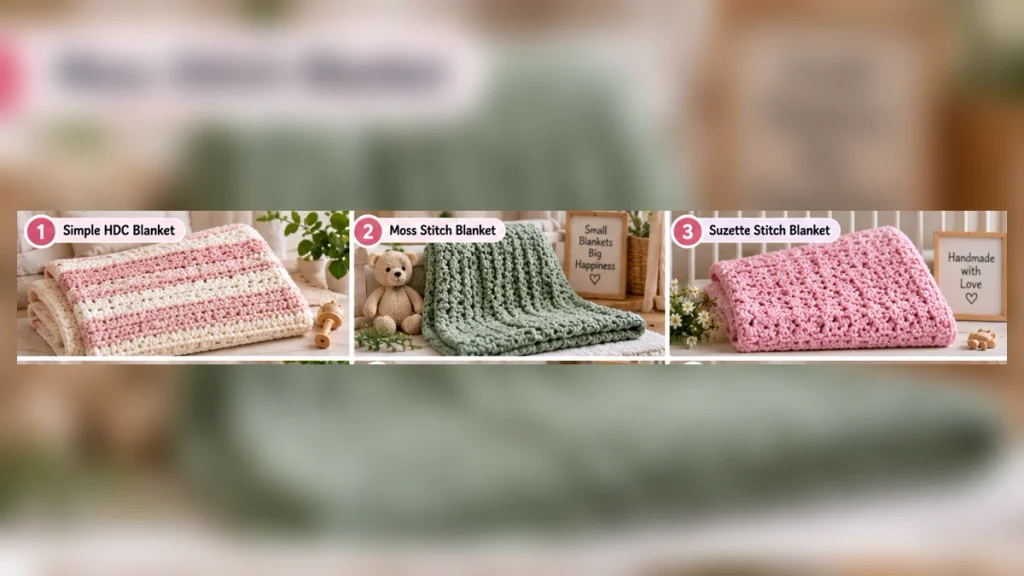
1. Simple Half Double Crochet Newborn Blanket
If this is your first blanket, start here.
Half double crochet creates a fabric that’s simple, soft and relatively quick to work.
You only need to learn:
- Chain
- Half double crochet
- Turning
- Basic border
A current beginner baby-blanket pattern from Lovable Loops uses HDC throughout with medium-weight yarn, demonstrating how well this basic stitch works for beginner blankets.
Best colors: cream, sage, dusty pink, beige or baby blue.
2. Moss Stitch Newborn Blanket
The moss stitch is an excellent choice if you want something simple that doesn’t look overly basic.
It alternates single crochet stitches with chain spaces to produce a neat woven appearance.
A recent newborn moss-stitch design uses a 5 mm hook and finishes at approximately 30 × 30 inches.
This would make an especially strong Pinterest design because close-up photographs show the stitch definition beautifully.
3. Textured Suzette Stitch Baby Blanket
Want more texture without jumping into advanced crochet?
Try Suzette stitch.
It combines basic single and double crochet stitches to create a denser, pebbled surface.
The big advantage is repetition: once you’ve learned the row, you can continue repeating it rather than constantly checking complicated instructions.
That’s exactly the type of simple construction currently appearing in newborn-focused beginner patterns.
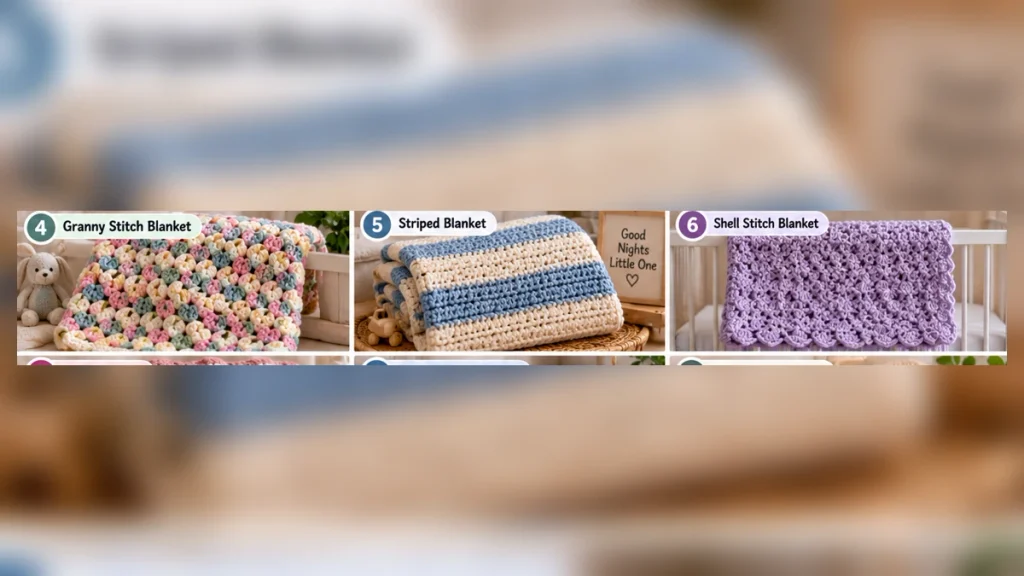
4. Classic Granny Stitch Newborn Blanket
If you’ve already learned our granny square crochet pattern, this is a natural next project.
Instead of creating dozens of separate motifs, you can use granny-style clusters to build a colorful baby blanket.
Choose:
Cream + sage + beige
for a modern neutral look, or:
Pink + lavender + cream
for a softer pastel style.
This also gives us an excellent internal-link opportunity to your Granny Square tutorial.
5. Modern Striped Newborn Blanket
Sometimes color does most of the design work.
Choose a basic stitch and alternate two or three colors.
For example:
Cream → Sage → Beige → Cream
Or:
Cream → Dusty Pink → Lavender → Cream
Striped newborn blankets are especially useful for beginners because you can create visual interest without learning a difficult stitch.
6. Shell Stitch Newborn Blanket
Shell stitches create a delicate scalloped texture.
They look more complicated than basic rows, making them a nice choice when you want a handmade blanket to feel more decorative.
Recent newborn crochet listings continue to feature shell and scalloped designs, particularly for gift-style blankets.
I’d classify this one as easy rather than absolute beginner.
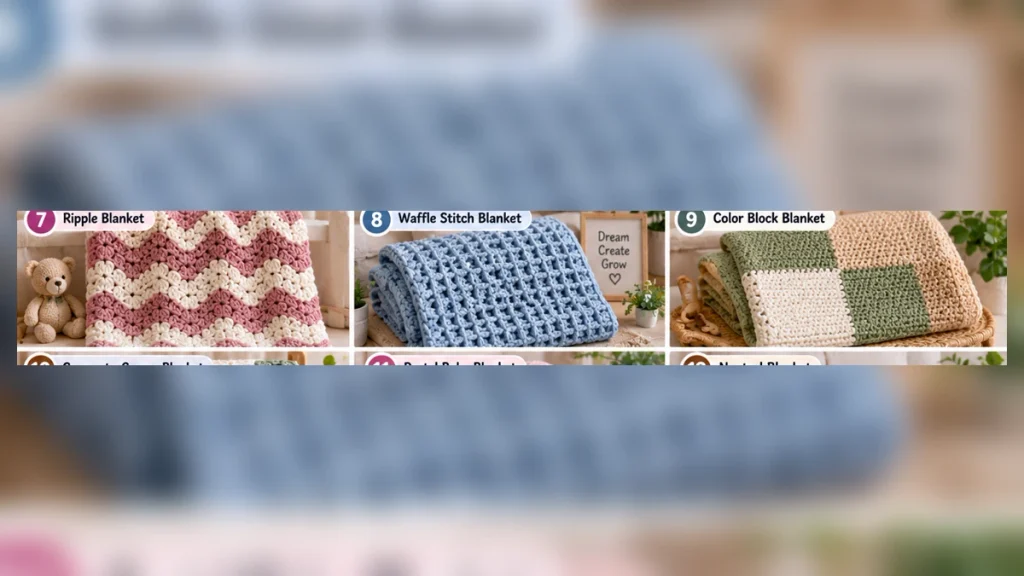
7. Ripple Crochet Baby Blanket
Ripple blankets use increases and decreases to create their recognizable wave shape.
The design works particularly well with three or more colors.
Try:
Sage + cream + mustard
for a modern palette.
Or:
Blue + cream + gray
for something calmer.
Ripple designs also remain present in current baby-blanket collections.
8. Waffle Stitch Newborn Blanket
If texture is your priority, consider waffle stitch.
Its raised geometric surface gives a handmade blanket a luxurious appearance.
Because textured patterns can require more yarn and additional stitch knowledge, I wouldn’t choose this as your very first crochet blanket.
But visually?
It’s one of the strongest designs in this entire list, especially for Pinterest.
9. Modern Color Block Baby Blanket
Instead of many narrow stripes, divide the blanket into several large areas of color.
For example:
40% cream
30% sage
30% beige
The construction can remain extremely simple while the color layout creates a modern look.
It’s perfect for minimalist nurseries.
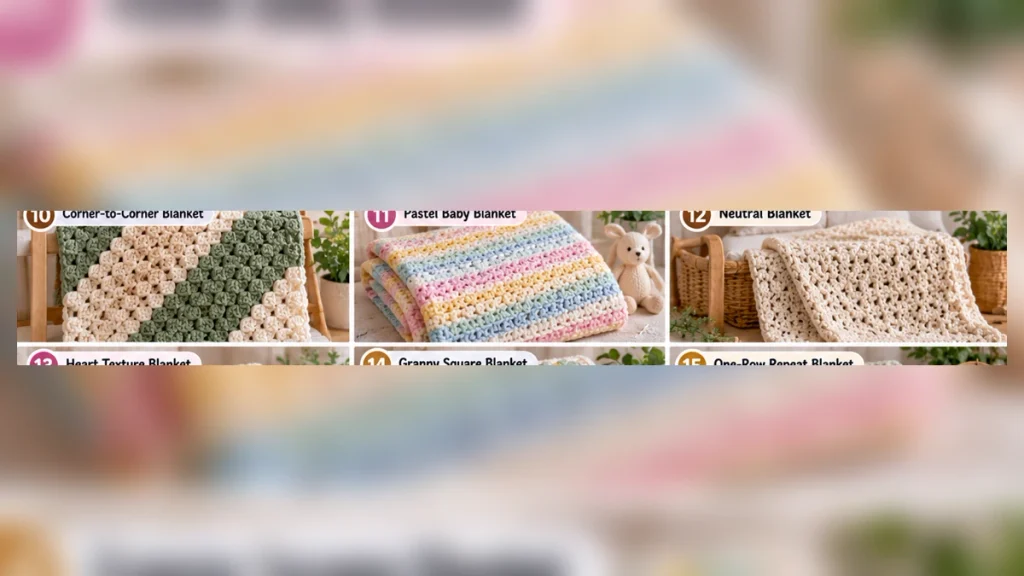
10. Corner-to-Corner Newborn Blanket
Corner-to-corner—or C2C—crochet is worked diagonally instead of row by row across the full width.
You begin small, increase until you reach the desired width, then decrease.
C2C remains popular for baby blankets, and a recently updated free baby blanket uses the technique with washable acrylic yarn.
Once you understand the construction, it also opens the door to graph-style crochet designs.
11. Soft Pastel Newborn Blanket
Here the focus isn’t a particular stitch.
It’s the palette.
Try combining:
- Blush pink
- Lavender
- Cream
- Pale yellow
- Sage
Use a simple stitch so the colors remain the star.
This one could perform particularly well on Pinterest because we can photograph folded blankets alongside matching yarn balls.
12. Neutral Gender-Neutral Baby Blanket
Not every baby blanket needs traditional pink or blue.
A modern combination such as:
Oatmeal + cream + sage
creates a timeless result.
Gender-neutral palettes are also useful when you’re crocheting a gift before knowing the nursery colors.
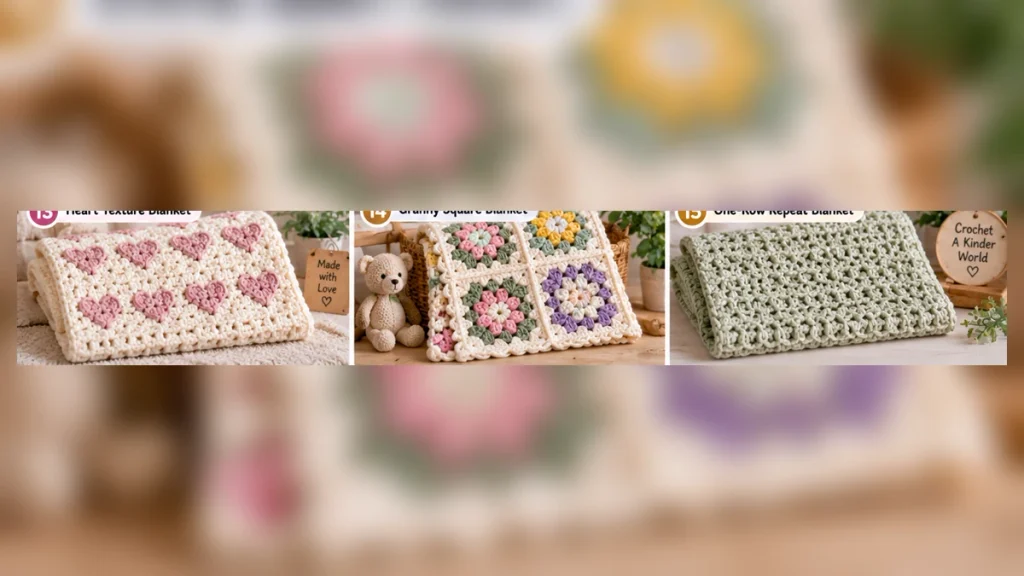
13. Heart Texture Newborn Blanket
This is where we can introduce a slightly more decorative pattern.
Small raised hearts can be incorporated using textured stitches.
A 2026 baby-blanket design from Cozy Nooks, for example, combines extended single crochet with popcorn stitches to create subtle heart details.
This type of project is especially attractive for:
baby showers + keepsake gifts + Pinterest.
14. Granny Square Newborn Blanket
Instead of one continuous blanket, crochet multiple squares and join them.
This is excellent for experimenting with color.
You could make every square identical or create a coordinated palette using:
Cream
Sage
Pink
Mustard
Lavender
And because we’ve already built a full beginner granny square crochet pattern, this gives us another strong internal link.
15. One-Row Repeat Newborn Blanket
This may be the most relaxing option in the list.
Learn one repeating row and continue until the blanket reaches your desired length.
One current 2026 design uses a one-row V-stitch repeat and finishes around 27 × 34 inches; other current beginner designs similarly emphasize easy repeating rows.
That’s exactly the philosophy we’ll use for our free pattern.
Free Easy Newborn Crochet Blanket Pattern
Now let’s make one.
Instead of sending readers somewhere else after showing them 15 ideas, this article should contain its own complete pattern.
I recommend a simple Half Double Crochet Stripe Blanket because it matches beginner intent and lets us internally link to your existing Half Double Crochet tutorial.
Pattern Details
| Detail | Our Pattern |
|---|---|
| Skill Level | Beginner |
| Finished Size | Approx. 30 × 32 in |
| Yarn | #4 Medium / Worsted |
| Hook | 5.5 mm |
| Crochet Terms | US |
| Main Stitch | Half Double Crochet |
| Construction | Worked flat in rows |
| Colors | 3 |
| Border | Single Crochet |
Materials
You’ll need:
- Approximately 700–900 yards of soft #4 yarn
- 5.5 mm crochet hook
- Yarn needle
- Scissors
- Measuring tape
- Optional stitch markers
Choose a yarn that’s soft against the skin and whose manufacturer care instructions suit the intended use.
Machine-washable yarn can be particularly practical for frequently washed baby projects; washable yarn is a recurring feature in current baby-blanket designs.
Abbreviations
ch — chain
hdc — half double crochet
sc — single crochet
sl st — slip stitch
st(s) — stitch(es)
This pattern uses US crochet terminology.
Step 1: Make a Gauge Swatch
Before starting the entire blanket, crochet a small test square.
This tells you whether your combination of yarn, hook and tension will produce the expected dimensions.
If your stitches are too tight, try a larger hook.
If they’re too loose, try a smaller hook.
Gauge becomes particularly useful here because we want an actual finished measurement rather than simply an arbitrary number of stitches.
Step 2: Crochet the Foundation
With Color A:
Ch 92.
Row 1
Hdc in the second chain from your hook and in each chain across.
Turn.
Row 2
Ch 1.
Hdc in each stitch across.
Turn.
Continue repeating Row 2.
Keep the same number of working stitches on every row.
A stitch marker in the first and last stitch can help beginners avoid accidentally dropping edge stitches.
Step 3: Create the Stripes
Instead of random color changes, use a predictable sequence.
For example:
10 rows Color A — Cream
6 rows Color B — Sage
4 rows Color C — Beige
Then reverse:
6 rows Color B
10 rows Color A
Continue this balanced sequence until the blanket approaches your desired length.
This creates a modern striped appearance without introducing a more difficult stitch pattern.
Step 4: Continue to Approximately 31 Inches
Keep repeating your HDC rows until the main blanket body measures roughly 31 inches long.
Don’t rely only on a predetermined row count.
Different crocheters have different tension, so measure the actual fabric.
Once you’re happy with the dimensions, finish the final row but don’t cut your border color if you’re continuing directly into the edging.
Step 5: Add a Simple Border
Switch to cream or your preferred border color.
Work single crochet evenly around the blanket.
At each corner, work approximately:
sc, ch 1, sc
into the corner space.
Continue around all four sides.
Join to your first stitch with a slip stitch.
For a slightly thicker border, work another round of single crochet.
Step 6: Finish the Blanket
Fasten off.
Use your yarn needle to securely weave in every loose end.
Trim excess yarn.
Gently shape or block the blanket according to the care requirements of your chosen fiber.
Your finished blanket should be approximately:
30 × 32 inches
depending on gauge and border.
Best Yarn for a Newborn Crochet Blanket
Instead of choosing yarn purely because it looks beautiful, consider four things:
Softness: The finished fabric should feel comfortable.
Washability: Baby items may need frequent washing.
Durability: The yarn should withstand repeated use.
Stitch definition: Beginners benefit from yarn that makes stitches easy to see.
Smooth medium-weight yarn is generally easier for a first blanket than very fuzzy yarn.
How Much Yarn Do You Need?
There isn’t one universal number.
Yarn usage changes dramatically depending on:
- Blanket dimensions
- Yarn weight
- Hook size
- Stitch
- Crochet tension
- Border
- Texture
For context, current newborn/baby patterns vary substantially: a 30-inch moss-stitch design uses multiple skeins totaling well over 800 yards of its main yarn plus contrast colors, while another 35-inch square medium-weight blanket specifies about 1,110 yards.
That’s why the yarn label and your gauge matter more than copying a universal yardage figure.
Best Colors for Newborn Crochet Blankets
You don’t have to limit yourself to traditional baby pink and blue.
Try:
Modern Neutral:
Cream + Beige + Sage
Soft Pastel:
Pink + Lavender + Cream
Woodland:
Sage + Mustard + Oatmeal
Ocean:
Blue + Teal + Cream
Minimal:
One solid cream or beige
For Pinterest specifically, I’d make our main blanket cream + sage + soft beige. It fits the visual identity we’re already building for CrochetCoach.
Common Beginner Mistakes
The Blanket Gets Narrower
You’re probably skipping the first or last stitch.
Count your stitches regularly.
The Blanket Gets Wider
You may be accidentally crocheting into the turning chain or adding stitches along the edges.
The Foundation Edge Is Tight
Try making your starting chain more loosely or using a slightly larger hook for the chain.
My Edges Aren’t Straight
Place stitch markers at both edges.
The Blanket Doesn’t Match the Expected Size
Check your gauge instead of simply adding random rows.
FAQ
What is the easiest crochet stitch for a newborn blanket?
Single crochet, half double crochet, moss stitch and other simple repeating patterns are all beginner-friendly options. HDC is particularly straightforward if you’ve already learned the basic stitch.
Can a beginner crochet a newborn blanket?
Absolutely. Current beginner baby-blanket patterns commonly rely on simple stitches and repetitive rows rather than advanced shaping.
What size should I crochet a newborn blanket?
Many newborn-focused crochet patterns fall around 30 inches square, although there is no universal crochet-pattern size. Examples currently available range from approximately 30 × 30 to 35 × 35 inches.
How long does it take to crochet one?
It depends heavily on the stitch, yarn weight, blanket size and your speed. Bulky-yarn designs can work up much faster than detailed DK or worsted-weight blankets; current quick-pattern roundups range from several-hour projects to weekend projects.
Is a crochet newborn blanket a good baby shower gift?
Yes as a handmade gift, but give the recipient appropriate care information and avoid presenting a loose blanket as safe unattended sleep bedding for a newborn.
Final Thoughts
The best crochet newborn blanket patterns don’t need complicated stitches.
Start with a design that matches your skill level, choose soft practical yarn, check your gauge, and let color and texture make the blanket special.
If you’re a complete beginner, the simple half double crochet version above is a good place to start. Once you’re comfortable keeping the edges straight, you can move on to moss stitch, ripples, granny squares, textured hearts and more advanced designs.
And one newborn blanket can become the beginning of an entire collection of handmade crochet gifts.