
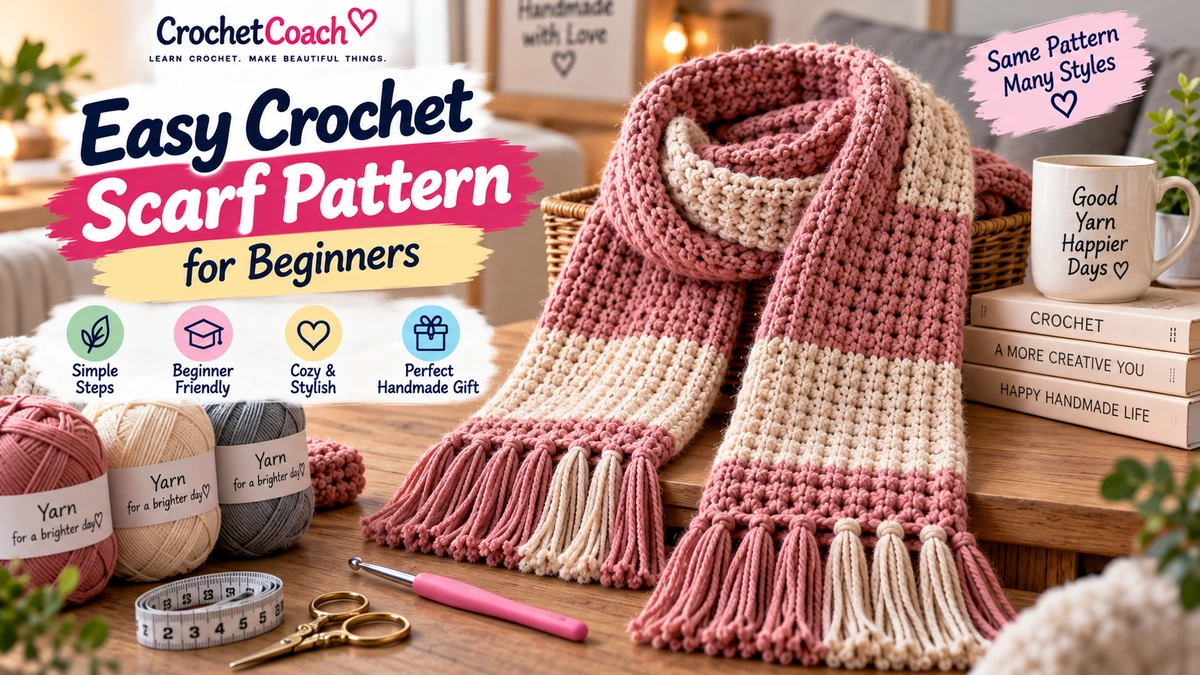
If you are looking for a relaxing first crochet project, this crochet scarf pattern is an excellent place to begin. A scarf lets you practice the same basic stitch repeatedly without complicated shaping, increases, decreases, or sewing.
This beginner-friendly pattern uses half double crochet (HDC) to create a soft, cozy scarf with a simple texture. You can easily change the width, length, yarn color, or add fringe to make it your own.
In this guide, you’ll learn how to crochet a scarf step by step, choose the right materials, adjust the size, keep your edges straight, and fix the most common beginner mistakes.
Crochet Scarf Pattern at a Glance
| Detail | Pattern Information |
|---|---|
| Skill Level | Beginner |
| Crochet Terms | US |
| Main Stitch | Half Double Crochet |
| Construction | Worked flat in rows |
| Yarn Weight | Medium #4 |
| Hook | 5.5 mm (I-9) |
| Approx. Width | 7–8 in / 18–20 cm |
| Approx. Length | 60–65 in / 152–165 cm |
| Optional | Fringe |
| Difficulty | Easy |
Finished measurements are approximate. Your gauge, yarn, hook size, and tension will affect the final dimensions.
Materials You’ll Need
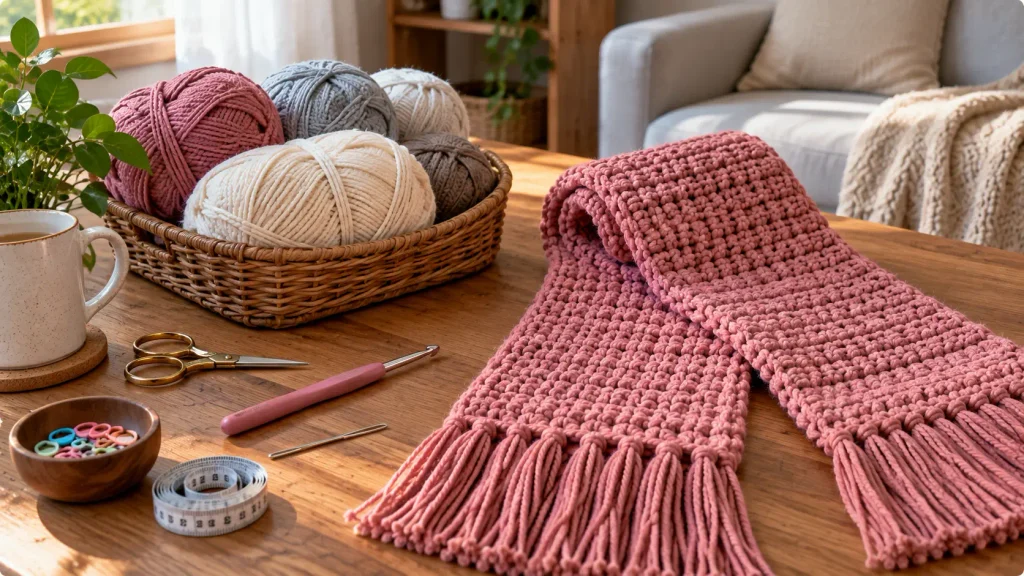
To make this easy crochet scarf, gather:
- Medium #4 yarn
- 5.5 mm crochet hook
- Scissors
- Yarn needle
- Measuring tape
- Stitch markers, optional
For a standard adult scarf, plan for approximately 400–600 yards of medium-weight yarn. The exact amount will depend on your gauge, desired dimensions, yarn characteristics, and whether you add fringe.
Always check your yarn label before starting.
Crochet Abbreviations
This pattern uses US crochet terminology.
| Abbreviation | Meaning |
|---|---|
| ch | Chain |
| hdc | Half Double Crochet |
| st | Stitch |
| sts | Stitches |
If you are new to crochet abbreviations, the Craft Yarn Council maintains a useful standardized list of common crochet terms.
Before You Start: Understanding the Construction
This scarf is made as one long rectangle.
The basic construction is:
Foundation chain → HDC rows → Continue to desired length → Finish → Optional fringe
There is no complicated shaping.
That simplicity makes scarves particularly useful for practicing consistent tension and learning how to recognize your first and last stitch.
Easy Crochet Scarf Pattern
Finished Size
The sample pattern is designed to finish at approximately:
7–8 inches / 18–20 cm wide
and
60–65 inches / 152–165 cm long
You can make it shorter, longer, wider, or narrower using the customization instructions later in this guide.
Gauge
A useful starting gauge for this project is approximately:
13–14 HDC × 10 rows = 4 × 4 inches / 10 × 10 cm
Gauge is not as critical for a scarf as it is for a fitted sweater or hat.
However, it still affects the final dimensions and yarn requirements.
If your stitches are considerably larger or smaller, use the scarf’s physical measurements rather than relying only on the suggested stitch count.
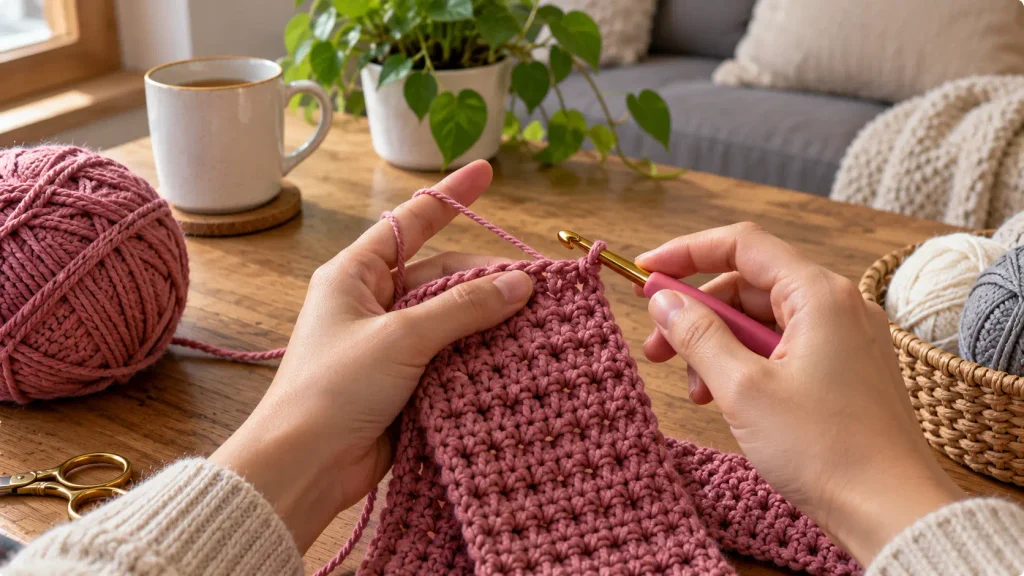
Step 1: Make a Slip Knot
Start by making a slip knot and placing it on your crochet hook.
The loop should slide smoothly along the hook.
Avoid pulling it excessively tight.
Your slip knot is simply the starting point and is not counted as a crochet stitch.
Step 2: Crochet the Foundation Chain
Chain 26.
Try to keep your chains relaxed and approximately the same size.
A foundation chain that is much tighter than the rest of your crochet can cause the bottom of the scarf to pull inward.
If you naturally crochet tight chains, consider deliberately relaxing your tension while making the foundation.
Step 3: Crochet the First Row
Work:
HDC in the second chain from the hook and in each chain across.
At the end of the row, you should have:
25 HDC
Turn your work.
Step 4: Crochet the Second Row
Chain 1.
Work:
1 HDC in each stitch across.
You should still have:
25 HDC
Turn.
The chain 1 in this pattern does not count as a stitch.
Step 5: Continue the Scarf
Repeat Row 2:
Ch 1, HDC in every stitch across, turn.
Continue until your scarf reaches approximately:
60–65 inches / 152–165 cm
or your preferred length.
Check your stitch count occasionally.
Each row should remain:
25 stitches
This simple habit prevents one of the most common beginner problems: accidentally making a scarf narrower or wider as you crochet.
Step 6: Finish the Scarf
Once the scarf reaches your desired length, finish the final row.
Cut the yarn, leaving a tail of several inches.
Pull the yarn through the final loop and tighten gently.
Use a yarn needle to weave the yarn tail securely into the fabric.
Repeat for your starting tail.
Your basic scarf is complete.
Optional: Add Fringe
Fringe can give a simple scarf a more finished look.
Cut several equal lengths of yarn.
A useful starting length is around:
10–12 inches / 25–30 cm
Remember that each strand will become shorter once folded.
Group a few strands together and fold them in half.
Insert your crochet hook through a stitch along the short edge of the scarf.
Pull the folded center of the yarn through the stitch to create a loop.
Pass the yarn ends through that loop.
Pull gently to secure.
Repeat across both ends of the scarf.
Once all fringe is attached, trim the ends evenly.
How to Make the Scarf Wider
The starting chain controls the width.
For this pattern:
26 chains → approximately 7–8 inches wide
If you want a wider scarf, add more chains.
For example, you might try:
30–35 chains
for a wider scarf, depending on your gauge.
For a narrower scarf, use fewer chains.
Because everyone’s crochet tension differs, measuring your foundation row is more reliable than treating a specific chain count as universal.
How to Make the Scarf Longer
The number of rows controls the length.
Simply continue repeating:
Ch 1, HDC across, turn
until the scarf reaches your preferred length.
This makes the pattern extremely easy to customize.
You don’t need to calculate a complicated repeat.
Crochet Scarf Size Guide
There is no single required scarf size. Personal preference, height, styling, and intended use all matter.
These measurements can be used as general starting points:
| Scarf Style | Approx. Width | Approx. Length |
|---|---|---|
| Child | 4–6 in | 36–48 in |
| Teen | 6–7 in | 50–60 in |
| Adult | 7–8 in | 60–65 in |
| Long Adult | 7–9 in | 65–75 in |
| Oversized | 9–12+ in | 70–80+ in |
Always consider the individual wearer when possible, especially when making scarves for children.
How to Keep Crochet Scarf Edges Straight
Uneven edges are one of the most common problems when learning how to crochet a scarf.
Usually, the problem isn’t your main stitch.
It is the first or last stitch of the row.
If you accidentally skip the final stitch, the scarf gradually becomes narrower.
If you accidentally work an extra stitch into the turning chain or edge, the scarf becomes wider.
The easiest solution is simple:
Count your stitches.
For this pattern, every standard row should have:
25 HDC
You can also place a stitch marker into the first and last stitch of each row while learning.
Why Is My Crochet Scarf Getting Narrower?
The most likely cause is accidentally losing stitches.
Check:
- The first stitch
- The final stitch
- Your stitch count
If you started with 25 HDC and later have 23, you have skipped stitches somewhere.
Undo the affected rows if necessary and return to the correct stitch count.
Why Is My Crochet Scarf Getting Wider?
You are probably adding stitches accidentally.
This often happens when beginners work into both the last real stitch and a turning chain that isn’t supposed to count as a stitch.
Count each row before continuing.
If the pattern calls for 25 stitches, maintain 25 stitches.
Why Is My Foundation Edge Too Tight?
A tight starting chain can make one edge shorter than the rest of the scarf.
You have several options:
- Relax your chain tension.
- Use a slightly larger hook only for the foundation chain.
- Practice making evenly sized chains.
- Restart if the edge is significantly distorted.
A little variation is normal, especially on your first project.
Why Is My Scarf Curling?
Slight curling can happen due to tension, yarn characteristics, or differences between the foundation edge and the main fabric.
Check whether your starting chain is too tight.
You can also gently block the finished scarf if the yarn fiber and care instructions allow it.
Severe curling may indicate a significant tension difference.
Choosing Yarn for a Crochet Scarf
Your yarn choice can dramatically change the finished scarf.
Acrylic Yarn
Acrylic is widely available and comes in many colors.
It can be an affordable choice for beginner projects.
Wool and Wool Blends
Wool can provide excellent warmth for cold-weather scarves.
Some people are sensitive to particular wool fibers, so consider how the yarn feels against the neck.
Cotton
Cotton can create a different drape and feel.
It may be more appropriate for lighter scarves depending on yarn weight and climate.
Blended Yarn
Fiber blends can combine characteristics such as softness, warmth, durability, or easier care.
Whatever fiber you choose, check the manufacturer’s washing and care instructions.
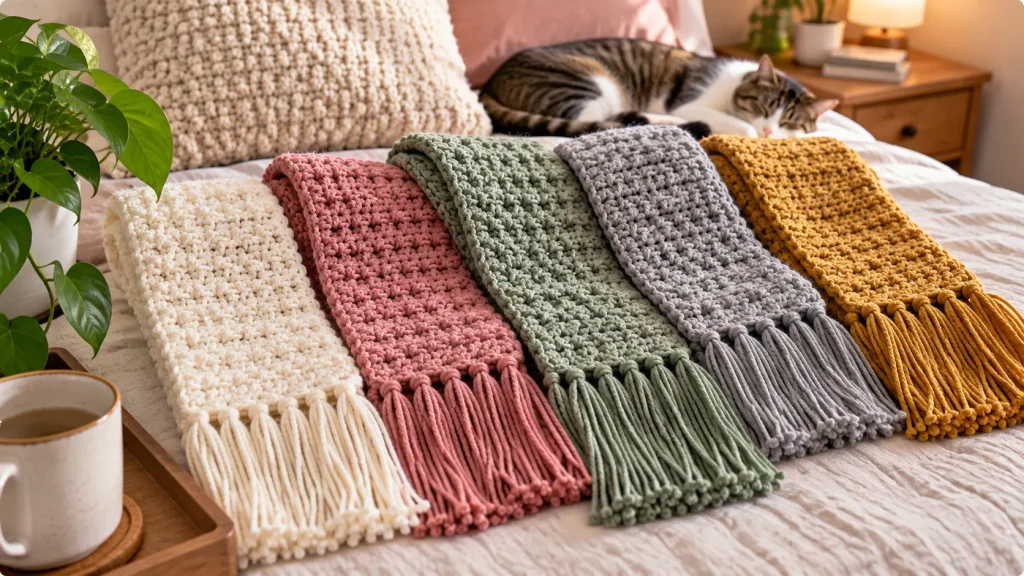
Best Colors for a Beginner Crochet Scarf
When learning crochet, medium or light solid colors can make your stitches easier to see.
Consider:
- Cream
- Sage green
- Dusty pink
- Light blue
- Beige
- Mustard
- Soft gray
Very dark yarn can make individual stitches harder to distinguish.
Highly textured or fuzzy yarn can also make learning more difficult because the stitch structure is less visible.
Once you are comfortable identifying stitches, experiment with any colors or textures you like.
Easy Striped Crochet Scarf
You can transform this basic pattern into a striped scarf without changing the construction.
Try changing colors every:
- 2 rows
- 4 rows
- 6 rows
- 10 rows
For a simple two-color scarf:
Rows 1–6: Color A
Rows 7–12: Color B
Continue alternating.
You can also create irregular stripes for a more playful design.
Color-Block Crochet Scarf
For a modern color-block effect, divide the scarf into large sections.
For example:
First third: Cream
Middle third: Sage
Final third: Dusty pink
The stitch pattern remains exactly the same.
Only the yarn color changes.
Two-Color Crochet Scarf
Another simple option is to crochet approximately half of the scarf in one color and the second half in another.
Choose colors with enough contrast to make the transition noticeable.
Neutral combinations can also look stylish:
- Cream + beige
- Gray + black
- Brown + cream
- Navy + light gray
How to Make a Chunky Crochet Scarf
You can use thicker yarn to create a chunkier version, but don’t simply use the same stitch count and expect the same dimensions.
Thicker yarn generally produces larger stitches.
Instead:
- Choose your chunky yarn.
- Check the yarn label for an appropriate hook range.
- Make a small swatch.
- Measure your stitches.
- Adjust the starting chain until you reach your desired width.
- Crochet until you reach your desired length.
This measurement-based approach works with almost any yarn.
How to Make an Extra-Long Scarf
If you prefer scarves that wrap around the neck multiple times, simply continue adding rows.
A length around:
70–75 inches
may work well for many longer scarf styles.
For a dramatic oversized design, you can go longer.
Remember that increasing the length also increases yarn consumption.
How to Make a Matching Beanie and Scarf
A handmade scarf can be paired with a crochet beanie using:
- The same yarn
- Matching colors
- Similar ribbing or texture
- Coordinating pom-poms or fringe
If you already made our beginner crochet beanie, using the same yarn for both projects can create a simple matching winter set.
Easy Crochet Scarf Variations
Once you understand the basic pattern, try creating:
Classic Solid Scarf
Use one color from beginning to end.
Striped Scarf
Alternate two or more colors.
Color-Block Scarf
Use large sections of contrasting colors.
Fringe Scarf
Add yarn fringe to both short edges.
Extra-Wide Scarf
Increase the foundation chain.
Extra-Long Scarf
Add additional rows.
Chunky Scarf
Use thicker yarn and adjust the stitch count according to your gauge.
Pastel Scarf
Combine soft pink, lavender, cream, or sage.
The basic rectangle construction gives you plenty of room to experiment.
Common Beginner Mistakes
1. Not Counting Stitches
This is one of the fastest ways to create uneven edges.
Count periodically.
2. Making the Foundation Chain Too Tight
A tight foundation can distort the entire scarf.
3. Accidentally Adding Edge Stitches
Learn where your first and last real stitches are.
4. Changing Tension
Your first few rows may be tighter or looser than later rows.
Try to maintain a comfortable, consistent grip.
5. Choosing Difficult Yarn
Very fuzzy or very dark yarn can make learning harder.
6. Ignoring Measurements
Your stitch count may produce a different size from someone else’s because your gauge is different.
Measure the actual fabric.
Tips for a Better Crochet Scarf
Practice Before Starting
Crochet a few small HDC rows first if the stitch is new to you.
Use Stitch Markers
Mark the first and last stitch while learning.
Measure Regularly
Don’t wait until the scarf is finished to discover that it is much longer or shorter than expected.
Don’t Crochet Too Tightly
Your hook should move comfortably through the loops.
Keep Your Yarn Consistent
Changing yarn brands or weights halfway through may affect width and texture.
Weave Ends Securely
Don’t simply cut yarn tails close to the fabric.
Use a yarn needle to weave them through multiple stitches.
How Long Does It Take to Crochet a Scarf?
The time required varies greatly depending on:
- Crochet experience
- Yarn thickness
- Stitch speed
- Scarf dimensions
- Number of color changes
- Fringe or other finishing details
A beginner may work on the project across several sessions.
There is no need to rush.
A simple scarf is useful precisely because the repetitive rows give you time to become comfortable with your stitches.
What Can You Learn From This Project?
This beginner scarf helps you practice several fundamental crochet skills:
- Making a slip knot
- Creating a foundation chain
- Half double crochet
- Turning your work
- Identifying stitches
- Maintaining stitch count
- Controlling tension
- Measuring crochet fabric
- Fastening off
- Weaving in ends
- Changing colors, optionally
These skills transfer directly to many future crochet projects.
Frequently Asked Questions
Is a scarf a good first crochet project?
Yes. A basic scarf is one of the most approachable beginner projects because it can be constructed as a simple rectangle without shaping.
What is the easiest stitch for a crochet scarf?
Several basic stitches work well. This pattern uses half double crochet because it is simple, creates fabric relatively quickly, and produces a pleasant texture.
How wide should a beginner crochet scarf be?
Around 7–8 inches is a useful starting point for many adult scarves, but there is no mandatory width. You can customize it according to the wearer’s preference.
How long should a crochet scarf be?
Around 60–65 inches is a useful starting range for a standard adult scarf. Shorter, longer, and oversized scarves are also common.
How many chains do I need for a crochet scarf?
For this pattern using the suggested yarn, hook, and approximate gauge, start with 26 chains. If your gauge differs or you want another width, adjust the foundation chain accordingly.
How much yarn do I need for a crochet scarf?
For this beginner pattern, approximately 400–600 yards of medium #4 yarn is a reasonable planning range. Your actual usage depends on size, gauge, yarn, and optional fringe.
Can I make this scarf with chunky yarn?
Yes. Use an appropriate hook for your chosen yarn and adjust the number of starting chains to reach your desired width.
Can I make this scarf without fringe?
Absolutely. Fringe is completely optional.
Why are the sides of my crochet scarf uneven?
You may be adding or losing stitches at the beginning or end of your rows. Count your stitches regularly and consider using stitch markers at both edges.
Final Thoughts
This crochet scarf pattern is simple enough for a first project while still producing something practical and customizable.
Remember the basic formula:
Chain 26 → HDC across → Keep 25 stitches → Repeat rows → Measure → Finish → Add fringe if desired
More importantly, learn to work from measurements rather than relying entirely on stitch counts.
Once you understand how the width and length are controlled, you can use the same basic pattern to create short scarves, oversized scarves, striped designs, color-block scarves, chunky winter accessories, and matching crochet sets.
Take your time, count your stitches, and enjoy watching a simple foundation chain gradually become your first handmade scarf.