
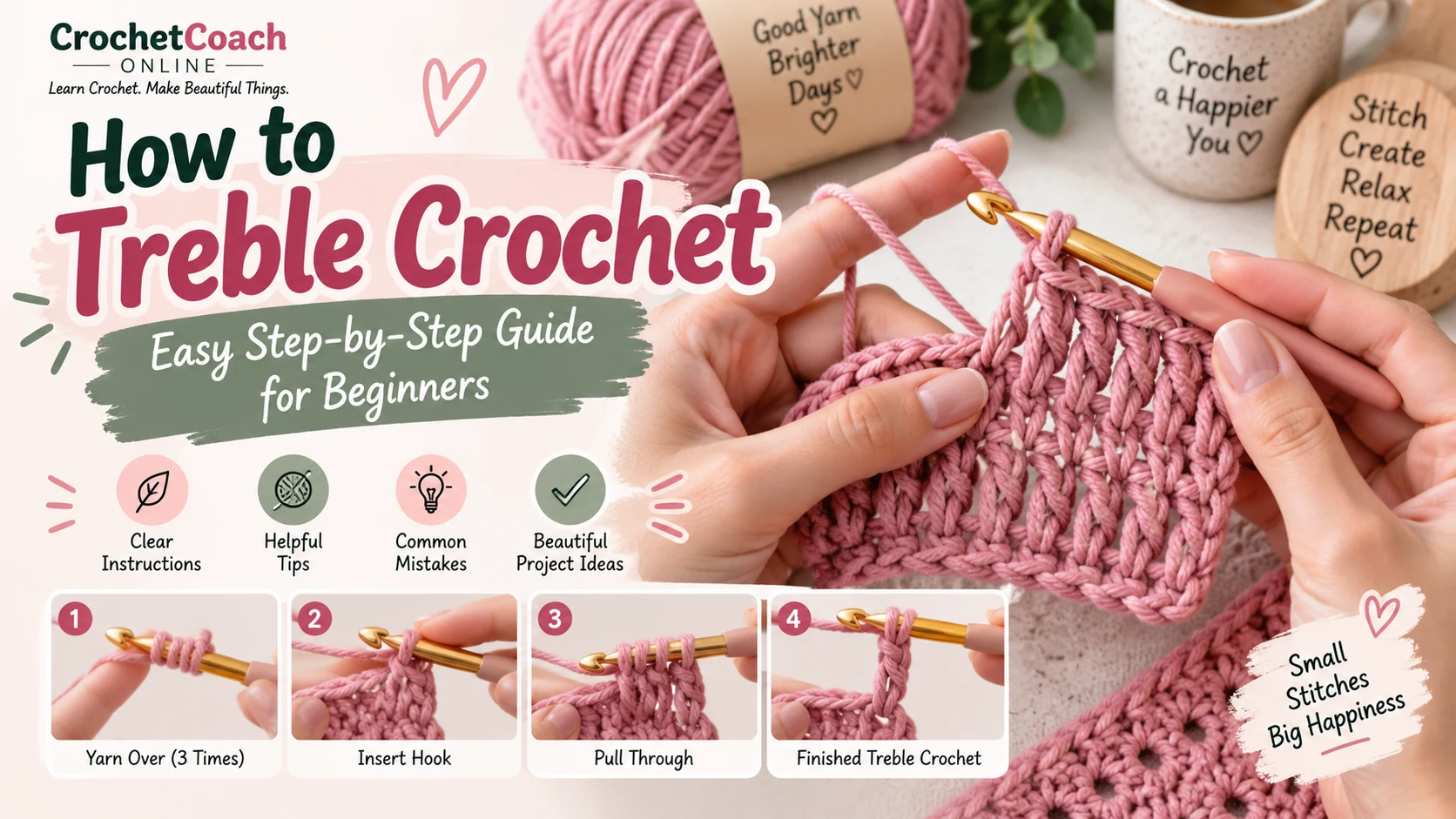
Treble crochet is a tall, airy crochet stitch that works up quickly and creates beautiful drape and texture. It is a useful stitch for blankets, scarves, shawls, garments, openwork patterns, and many other crochet projects.
If you already know how to chain or double crochet, learning how to treble crochet is a natural next step.
In this beginner-friendly guide, you’ll learn exactly how to make the treble crochet stitch step by step, how many loops should be on your hook, how to work into a foundation chain, how to start another row, and how to avoid common beginner mistakes.
Quick answer: To make a U.S. treble crochet, yarn over twice, insert your hook into the stitch, yarn over and pull up a loop, then yarn over and pull through two loops three times.
What Is Treble Crochet?
Treble crochet is one of the basic tall crochet stitches.
In U.S. crochet terminology, it is abbreviated as tr. The Craft Yarn Council lists tr as the standardized abbreviation for treble crochet.
A treble crochet is taller than a double crochet because you start with two yarn overs instead of one.
That extra height produces a fabric that is generally:
- Taller
- More open
- More flexible
- Faster to build vertically
- Great for drapey and lacy projects
The basic movement may look complicated at first, but there is an easy rhythm to remember:
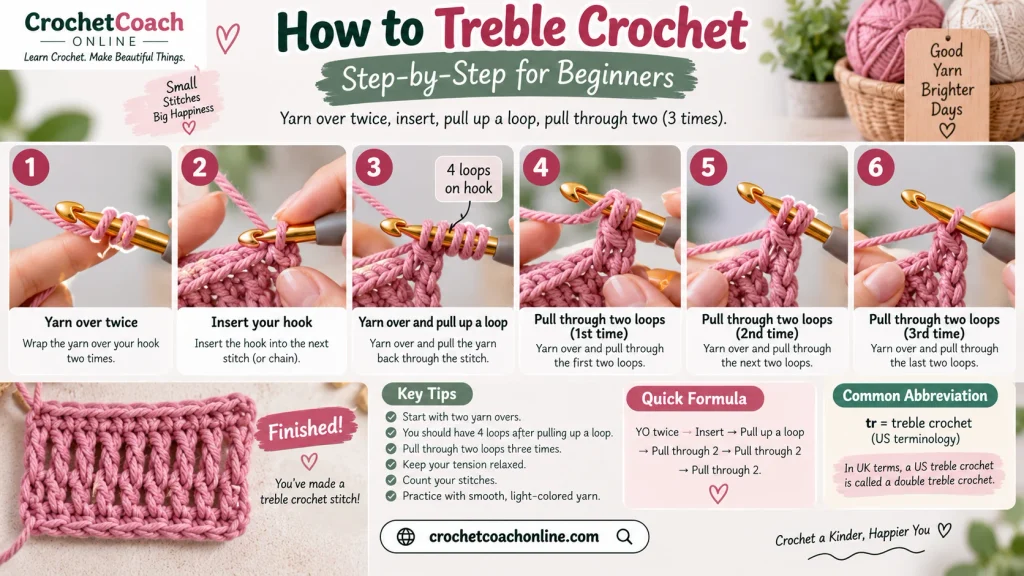
Yarn over twice → Insert → Pull up a loop → Pull through 2 → Pull through 2 → Pull through 2.
That’s it.
U.S. vs. U.K. Treble Crochet: Important!
Before you start, there is one terminology difference you need to know.
This tutorial uses U.S. crochet terminology.
A U.S. treble crochet (tr) is called a double treble crochet (dtr) in U.K. terminology.
| U.S. Term | Abbreviation | U.K. Equivalent |
|---|---|---|
| Single Crochet | sc | Double Crochet |
| Half Double Crochet | hdc | Half Treble |
| Double Crochet | dc | Treble |
| Treble Crochet | tr | Double Treble |
This distinction is confirmed by the standardized terminology from the Craft Yarn Council.
This matters because following a U.K. pattern as though it used U.S. terms can dramatically change the height and appearance of your project.
What You’ll Need
You don’t need anything special to practice treble crochet.
Grab:
- Medium-weight yarn
- A crochet hook suitable for your yarn
- Scissors
- Yarn needle
- Optional stitch markers
For your first practice swatch, choose a smooth, light-colored yarn.
Dark, fuzzy, or highly textured yarn can make it harder to see individual stitches and loops.
Check your yarn label for the recommended crochet hook size.
Common Treble Crochet Abbreviations
Here are a few abbreviations you’ll see throughout crochet patterns:
tr = treble crochet
ch = chain
st = stitch
sts = stitches
yo = yarn over
These follow standard U.S. crochet abbreviations.
How to Treble Crochet Step by Step
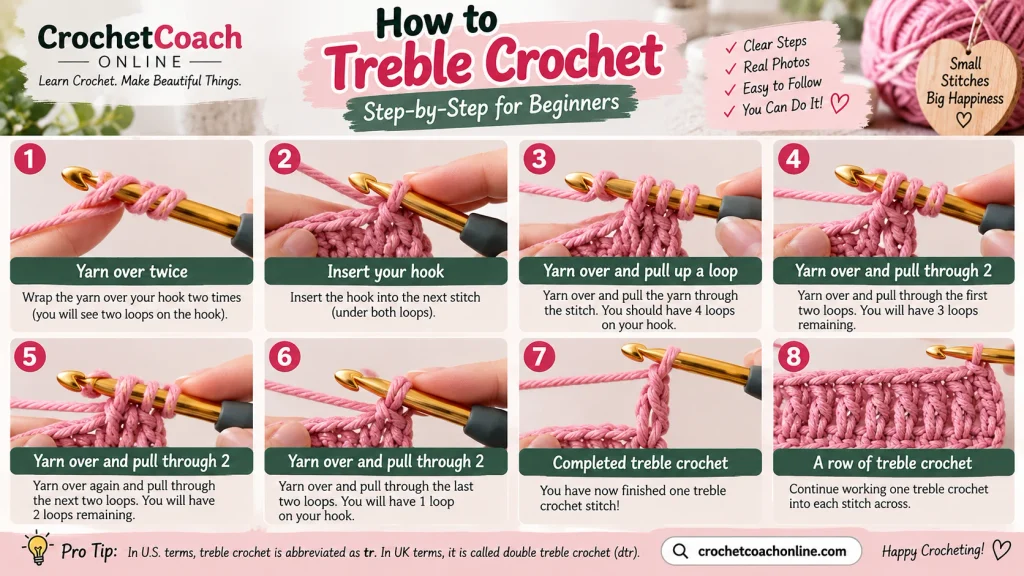
Now let’s make your first stitch.
Step 1: Yarn Over Twice
Wrap the working yarn over your crochet hook two times.
This is the most important thing to remember when beginning a treble crochet.
A double crochet starts with one yarn over.
A treble crochet starts with two.
You should now see two wraps around the shaft of your hook, plus the original working loop.
Step 2: Insert Your Hook
Insert the hook into the next stitch.
For a standard treble crochet worked into a previous row, insert the hook under both top loops of the stitch unless your pattern tells you otherwise.
Step 3: Yarn Over and Pull Up a Loop
Yarn over again.
Pull that yarn back through the stitch.
Stop and count.
You should now have:
4 loops on your hook.
If you don’t have four loops, check whether you remembered both yarn overs before inserting the hook.
Step 4: Yarn Over and Pull Through Two Loops
Yarn over again.
Pull the yarn through only the first two loops on your hook.
You should now have:
3 loops remaining.
Step 5: Yarn Over and Pull Through Two Again
Yarn over.
Pull through the next two loops.
Now you should have:
2 loops remaining.
Step 6: Yarn Over and Pull Through the Final Two Loops
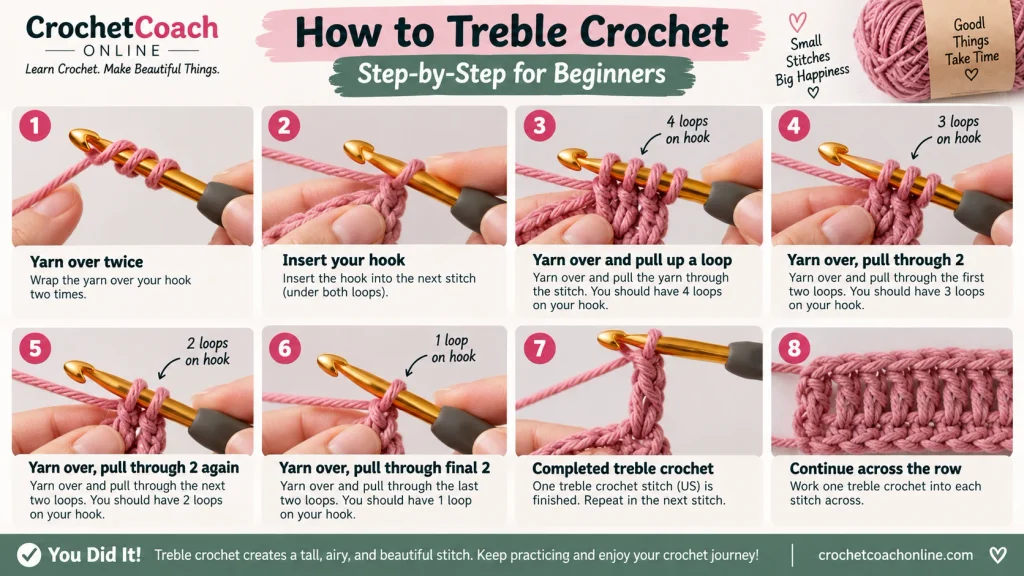
Yarn over one final time.
Pull through the last two loops.
You should now have:
1 loop on your hook.
Congratulations — you’ve completed one treble crochet!
Yarnspirations demonstrates the same core sequence in its treble crochet tutorial.
See Yarnspirations’ Treble Crochet Tutorial
How to Treble Crochet Into a Foundation Chain
Let’s turn the stitch into an actual row.
When learning the traditional foundation-chain method, the Craft Yarn Council’s instructional material and Yarnspirations both demonstrate working the first treble crochet into the fifth chain from the hook.
Here’s the process:
- Make a slip knot.
- Crochet your foundation chain.
- Yarn over twice.
- Insert your hook into the fifth chain from the hook.
- Yarn over and pull up a loop.
- You should have four loops.
- Yarn over and pull through two.
- Yarn over and pull through two.
- Yarn over and pull through the final two.
- Work another treble crochet into each remaining chain.
You now have your first row of treble crochet.
Easy Treble Crochet Practice Swatch
The best way to learn the stitch is to practice several rows rather than making one or two isolated stitches.
Try this simple exercise.
Foundation
Chain 16.
Row 1
Treble crochet into the fifth chain from the hook.
Work one treble crochet into each remaining chain across.
Row 2
Make your turning chain according to the method you’re following, turn your work, and work one treble crochet in each stitch across.
Rows 3–6
Repeat Row 2.
Don’t worry about speed.
Your goals should be:
consistent tension + straight edges + correct stitch count.
Count your stitches after every row.
How Many Chains Do You Need to Turn Treble Crochet?
Because treble crochet is a tall stitch, its traditional turning chain is also taller than the turning chains used for shorter stitches.
However, there is an important detail:
Whether the turning chain counts as a stitch can vary between patterns and designers.
That’s why you should always read the pattern notes.
If the turning chain counts as a stitch, it becomes part of your stitch count.
If it doesn’t count as a stitch, you’ll normally work your first actual treble into the first stitch.
Don’t mix the two methods within the same project.
Consistency is what keeps your edges straight.
How to Count Treble Crochet Stitches
Look at the top of your crochet row.
Every completed treble crochet produces a small V shape at the top.
Each V represents one stitch.
For example:
12 V shapes = 12 stitches.
Treble crochet is tall, so the first and last stitches can sometimes be harder for beginners to identify.
An easy solution is to place a stitch marker in the first and last stitch of each row.
This can prevent one of the most common beginner problems: accidentally losing stitches at the edges.
Treble Crochet vs. Double Crochet
Treble crochet and double crochet use similar movements, but they’re not the same stitch.
| Feature | Double Crochet | Treble Crochet |
|---|---|---|
| Initial yarn overs | 1 | 2 |
| Height | Medium-tall | Tall |
| Fabric | Moderately open | More open |
| Vertical growth | Fast | Faster |
| U.S. abbreviation | dc | tr |
If you already know double crochet, there’s an easy way to think about treble crochet:
Treble crochet = double crochet with one extra yarn over and one extra pull-through-two step.
What Is Treble Crochet Used For?
Because treble crochet is tall, it creates height quickly.
Its more open structure also makes it useful when you don’t want an extremely dense fabric.
You’ll commonly see tall stitches used in:
- Scarves
- Shawls
- Wraps
- Blankets
- Afghans
- Cardigans
- Sweaters
- Openwork designs
- Granny-style motifs
- Lacy crochet projects
- Decorative stitch patterns
It can also be combined with shorter stitches to create interesting changes in height and texture.
7 Common Treble Crochet Mistakes
Treble crochet is beginner-friendly once you understand the sequence, but there are a few mistakes to watch for.
1. Yarning Over Only Once
This is probably the easiest mistake to make.
Remember:
Double crochet = one initial yarn over.
Treble crochet = two initial yarn overs.
If you yarn over only once, you’re starting a double crochet.
2. Having the Wrong Number of Loops
After:
YO twice → insert hook → YO → pull up a loop
you should have exactly:
4 loops on your hook.
Count them before continuing while you’re learning.
3. Pulling Through Too Many Loops
Don’t try to pull through all four loops at once.
Treble crochet is completed in stages.
After pulling up your loop:
Pull through 2 → Pull through 2 → Pull through 2.
4. Crocheting Too Tightly
If your tension is extremely tight, getting your hook through the loops becomes frustrating.
Relax your grip.
The loops should move comfortably along the shaft of your crochet hook.
5. Skipping the First Stitch
The turning chain can make the first stitch difficult to see.
If your swatch becomes narrower with every row, there’s a good chance you’re accidentally skipping an edge stitch.
Use stitch markers.
6. Adding an Extra Stitch
The opposite can happen too.
If your work becomes wider with every row, you may be adding an extra stitch at the edge or working into a turning chain that isn’t supposed to count as a stitch.
Count every row.
7. Mixing U.S. and U.K. Crochet Terms
This is a major one.
Remember:
U.S. treble crochet = U.K. double treble crochet.
Always check which terminology your pattern uses before starting.
How to Make Your Treble Crochet Look Neater
Once you understand the basic movement, focus on consistency.
Try these tips:
- Keep your yarn overs approximately the same size.
- Don’t pull the yarn excessively tight.
- Keep your hook movements relaxed.
- Count every row.
- Mark your first and last stitches.
- Practice with smooth yarn.
- Keep the same turning-chain method throughout your project.
- Make a gauge swatch when size matters.
Gauge becomes particularly important for fitted projects such as sweaters and cardigans.
The Craft Yarn Council describes gauge as the number of stitches and rows within a given measurement and recommends checking it when a pattern’s finished size matters.
Craft Yarn Council Crochet Standards
Treble Crochet FAQ
What does TR mean in crochet?
TR is the standard U.S. abbreviation for treble crochet.
Is treble crochet the same as triple crochet?
In U.S. crochet, treble crochet is also sometimes referred to as triple crochet. Yarnspirations notes this alternative name in its beginner instructions.
Is treble crochet easy for beginners?
Yes.
It has more steps than single or double crochet, but the movement is repetitive. Once you remember to start with two yarn overs, the rest follows a simple pattern.
How many loops should be on the hook for treble crochet?
After yarning over twice, inserting the hook, yarning over again, and pulling up a loop, you should have:
Four loops on your hook.
How do you finish a treble crochet stitch?
Yarn over and pull through two loops.
Repeat this three times until only one loop remains on your hook.
Why is my treble crochet getting narrower?
You’re probably losing stitches at one or both edges.
Count your stitches after each row and mark your edge stitches.
Why is my treble crochet getting wider?
You may be accidentally adding stitches at the beginning or end of your rows.
Pay special attention to your turning chain and follow your pattern’s instructions about whether it counts as a stitch.
Is treble crochet taller than double crochet?
Yes.
Treble crochet begins with two yarn overs instead of one and produces a taller stitch.
What is U.S. treble crochet called in the UK?
A U.S. treble crochet corresponds to a U.K. double treble crochet.
Final Thoughts
Treble crochet may look complicated when you first see several loops wrapped around the hook, but the actual technique is surprisingly repetitive.
Just remember:
Yarn over twice → Insert hook → Pull up a loop → Pull through 2 → Pull through 2 → Pull through 2.
Practice a few rows slowly before worrying about speed.
Focus on consistent tension, count your stitches, and use stitch markers if your edges are difficult to identify.
Once you’ve mastered the basic treble crochet stitch, you’ll have another versatile technique you can use for airy scarves, blankets, shawls, garments, openwork patterns, and many other crochet projects.