
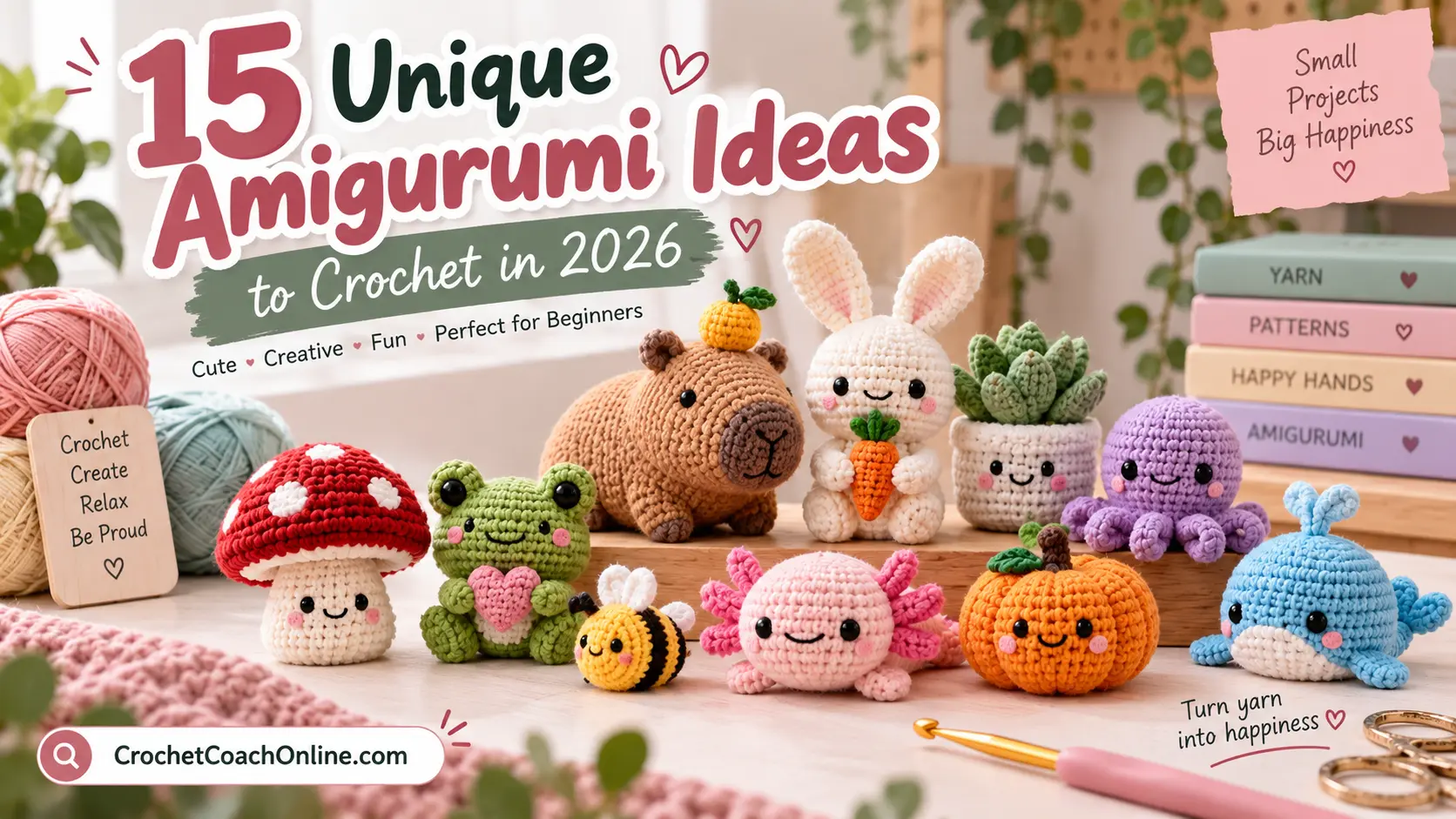
Amigurumi is no longer limited to classic teddy bears and simple crochet dolls. In 2026, crocheters are experimenting with tiny animals, whimsical food, fantasy creatures, plants, keychains, and adorable no-sew plushies.
That creativity is showing up in search trends too. Pinterest’s 2026 Hobbies Trend Report lists “unique amigurumi” up 56%, alongside growing interest in miniature and collectible crafts.
If you’re looking for something different to make next, these 15 unique amigurumi ideas offer plenty of inspiration—from beginner-friendly mini projects to unusual characters that can become handmade gifts, desk decorations, keychains, or collectibles.
What Is Amigurumi?
Amigurumi is the craft of crocheting or knitting small stuffed characters and objects. In crochet, most designs are created in rounds or continuous spirals and shaped with increases and decreases.
You don’t need dozens of advanced stitches to begin.
Many beginner amigurumi projects rely mainly on:
- Magic ring (MR)
- Chain (ch)
- Single crochet (sc)
- Slip stitch (sl st)
- Increase (inc)
- Decrease (dec)
- Working in rounds
- Basic sewing and embroidery
These abbreviations align with standard U.S. crochet terminology from the Craft Yarn Council.
A magic ring is particularly useful because it lets you tighten the center of your first round, avoiding the obvious hole that can appear when starting a circular piece.
1. Mini Capybara Amigurumi
Capybaras translate beautifully into amigurumi because of their recognizable rounded body, tiny ears, short legs and wonderfully calm expression.
A mini version can work as:
- A desk companion
- Keychain
- Backpack charm
- Small handmade gift
- Collectible crochet animal
Use warm brown or caramel yarn for the classic look, or experiment with pastel colors for something more playful.
Difficulty: Beginner–Intermediate
Key skills: Magic ring, single crochet, increases, decreases and sewing.
Content opportunity: This deserves its own future Crochet Coach Online tutorial:
Easy Capybara Amigurumi Crochet Pattern for Beginners
2. Cute Axolotl Amigurumi
An axolotl is an excellent choice when you want something more unusual than a traditional crochet animal.
Its distinctive external gills give you plenty of room to experiment with color.
Try combinations such as:
Pink + blush for a classic cute version.
Lavender + cream for a soft pastel design.
Black + purple for something more dramatic.
You can make a larger plush version or shrink the design into a mini collectible.
Difficulty: Beginner–Intermediate
Best feature: The colorful gills instantly make the finished character recognizable.
3. No-Sew Baby Octopus
No-sew amigurumi is particularly attractive when you dislike attaching lots of tiny arms, ears and legs.
A baby octopus is one of the best examples.
There are genuine beginner no-sew octopus patterns that rely on familiar amigurumi techniques such as the magic ring, single crochet, increases and decreases. Amigurumi.com, for example, currently offers a beginner no-sew baby octopus pattern using bulky yarn.
Difficulty: Beginner
Why make one?
It’s small, quick, cute and excellent for using different yarn colors.
This is another strong future article:
Easy No-Sew Octopus Amigurumi Pattern
4. Mushroom Amigurumi
Crochet mushrooms combine amigurumi with a cozy woodland aesthetic.
The basic design can be surprisingly simple:
Cap + stem + stuffing + embroidered details.
But don’t stop at the classic red mushroom with white spots.
Try:
- Pink fairy mushroom
- Pastel mushroom
- Tiny woodland mushroom
- Mushroom keychain
- Mushroom with a smiling face
- Mushroom family
- Cottagecore mushroom
Creating several sizes together can produce a charming miniature woodland display.
5. Frog Amigurumi
A crochet frog gives you lots of creative freedom.
Make it tiny and round, give it long legs, add a flower, create a little hat, or turn it into a keychain.
Green is obvious, but amigurumi doesn’t need to imitate nature exactly.
Try:
Sage green, pastel pink, lavender, yellow or even striped yarn.
The face is where much of the personality comes from. Slightly changing eye position or mouth embroidery can completely change the expression.
Difficulty: Beginner–Intermediate
6. Tiny Food Amigurumi
Why crochet only animals?
Tiny food characters can make an entire amigurumi collection.
Ideas include:
- Strawberry
- Avocado
- Cupcake
- Donut
- Sushi
- Croissant
- Peach
- Cherry
- Bubble tea
- Tiny cake
Give each one a tiny embroidered expression and suddenly an ordinary food item becomes a character.
This also fits nicely with Pinterest’s broader 2026 momentum around miniature crafts and collectible-scale creations.
7. Mini Bunny Amigurumi
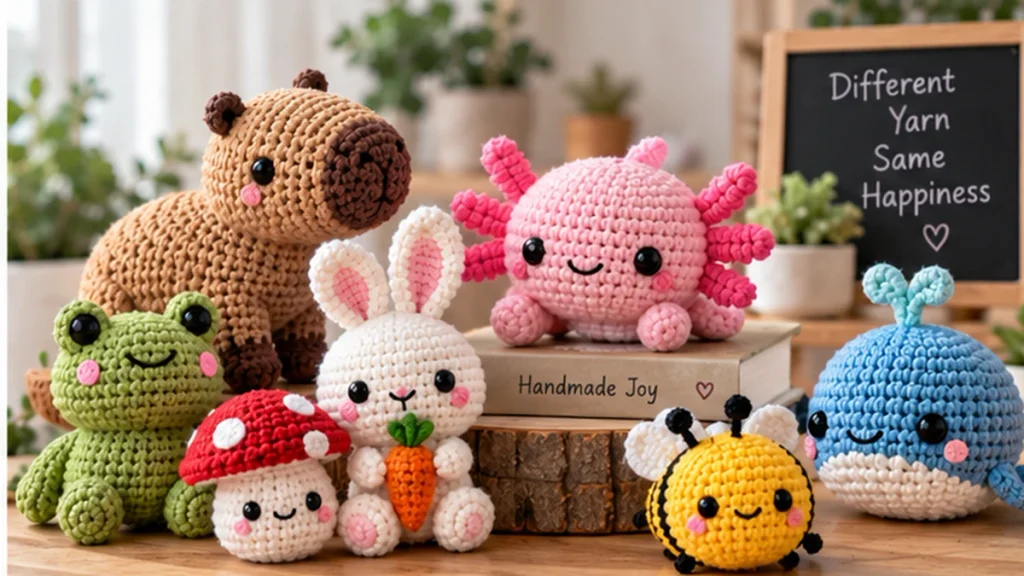
A tiny bunny is a classic that can still feel original with the right styling.
Instead of making another plain white rabbit, customize yours with:
- Floppy ears
- Tiny overalls
- Flower crown
- Mini scarf
- Pastel dress
- Carrot accessory
- Embroidered cheeks
Beginner bunny patterns commonly use the same core techniques found throughout amigurumi: magic ring, single crochet, increases and decreases.
That makes a bunny a useful project once you’ve learned the fundamentals.
8. Amigurumi Plants and Succulents
Here’s an advantage real plants can’t compete with:
Crochet plants don’t need water.
🌵
Create miniature:
- Cacti
- Succulents
- Flowers
- Potted vines
- Sunflowers
- Tulips
- Happy plants with faces
A small crochet pot combined with a cute plant character makes an excellent desk decoration.
You can also build a whole amigurumi garden rather than making one standalone project.
9. Tiny Sea Animal Collection
Instead of making one animal, create an entire underwater collection.
For example:
Baby seal + whale + octopus + turtle + jellyfish + starfish.
Small sea animals work especially well as amigurumi because many naturally have rounded forms.
Amigurumi.com has a beginner baby seal pattern measuring roughly 2 inches high that uses spiral crochet, magic ring, single crochet, increases and decreases—showing how compact these projects can be.
Arrange several together and you have a miniature crochet ocean.
10. Amigurumi Keychains
Sometimes smaller is better.
Take an ordinary amigurumi concept and turn it into a tiny keychain or bag charm.
Good candidates include:
- Frog
- Bear
- Mushroom
- Strawberry
- Bee
- Whale
- Bunny
- Mini heart
They’re attractive projects because they use relatively little yarn and can be completed faster than large plushies.
Just make sure every attachment is secure, particularly if the item will be carried on a bag.
11. Fantasy Creature Amigurumi
You don’t have to crochet something that exists in real life.
Invent your own creature.
Try:
- Baby dragon
- Tiny monster
- Mini unicorn
- Crochet ghost
- Forest spirit
- Winged cat
- Mini alien
Fantasy amigurumi is where you can really make the project your own.
Change the ears, horns, wings, colors and facial expression until your character has its own personality.
Pinterest angle: unusual designs fit particularly well with the rising interest in unique amigurumi, rather than producing another identical version of an established animal.
12. Cute Peas in a Pod
Three tiny peas tucked inside a crochet pod can make a surprisingly charming project.
This concept also works particularly well as a no-sew or low-sew design.
For example, an existing beginner no-sew Peas in a Pod design uses cotton yarn and core stitches including magic ring, single crochet, increases and decreases.
You can customize the faces so each pea has a different personality.
This would make a cute handmade friendship gift too.
13. Seasonal Mini Amigurumi
Create tiny characters around different seasons instead of relying on evergreen animals alone.
Spring
Flowers, chicks and bunnies.
Summer
Watermelon, ice cream and sea animals.
Fall
Pumpkins, mushrooms and little ghosts.
Winter
Snowmen, gingerbread characters and mini Christmas trees.
Small seasonal projects are also useful for practicing new techniques without committing to a large plushie.
For example, Amigurumi.com’s beginner pumpkin project uses spiral crochet, a magic ring, single crochet, increases and decreases.
14. Mini Amigurumi Family
Take one simple design and make it in several sizes.
For example:
Big bear + medium bear + tiny bear.
Or:
Large mushroom + medium mushroom + baby mushroom.
Changing yarn thickness, hook size or the underlying pattern dimensions can create a family effect.
You can also give every character a slightly different expression or accessory.
This works especially well for photography and Pinterest because the finished collection tells more of a visual story than a single isolated plushie.
15. Create Your Own Original Amigurumi Character
The most unique amigurumi might be the one that doesn’t have an existing character to copy.
Once you’re comfortable making basic shapes, start experimenting.
A character can often be broken into simple components:
Head → sphere
Body → sphere, oval or cylinder
Arms and legs → narrow tubes
Ears → flat or shaped pieces
Tail → tube or curved piece
Then customize:
- Colors
- Eye placement
- Ears
- Hair
- Clothing
- Horns
- Wings
- Accessories
Sketch the character before you start and write down your stitch counts as you crochet.
If it works, you’ve started developing your own original amigurumi design rather than simply following someone else’s pattern.
Which Amigurumi Idea Should a Beginner Try First?
If you’re completely new, don’t choose based only on which character looks cutest.
Start with a design that has:
- Few separate pieces
- Mostly single crochet
- Simple shaping
- Minimal color changes
- Little sewing
- Clear instructions
A small no-sew octopus, simple ball-shaped animal or tiny food character can be much easier than a detailed doll with hair, clothing, fingers and multiple accessories.
LoveCrafts similarly recommends building basic crochet skills before moving into simple amigurumi worked tightly in a spiral with a stitch marker.
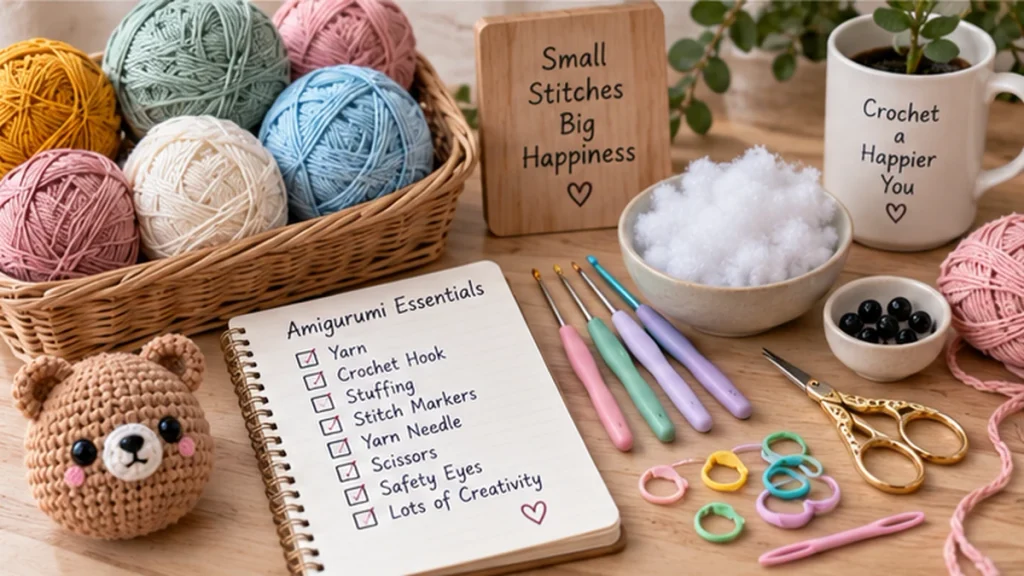
Essential Supplies for Amigurumi
You don’t need a huge collection of equipment.
A basic kit usually includes:
| Supply | Why You Need It |
|---|---|
| Crochet hook | Creates the stitches |
| Yarn | Forms your character |
| Stuffing | Gives the toy its shape |
| Stitch marker | Helps identify the start of a round |
| Yarn needle | Sewing and finishing |
| Scissors | Cutting yarn |
| Embroidery thread | Facial details |
| Pins | Positioning pieces before sewing |
Your pattern should determine the appropriate yarn and hook rather than choosing them blindly.
Why Amigurumi Often Uses a Smaller Hook
Amigurumi fabric generally needs to be fairly dense.
Large gaps between stitches can expose the stuffing and make shaping less defined.
That’s why amigurumi patterns may pair yarn with a relatively small hook and tight gauge.
Don’t make your tension painfully tight, though. The goal is a firm, even fabric that holds the stuffing—not sore hands.
Learn the Magic Ring
If you’re planning to make lots of amigurumi, the magic ring is worth learning.
You crochet your first stitches into an adjustable loop and then pull the tail to close the center.
This creates a cleaner center than a starting method that leaves a small visible hole. Amigurumi.com also documents a two-chain alternative for crocheters who find the magic ring difficult.
Beginner tip: Put a stitch marker in the first stitch of each round when working continuously. It becomes surprisingly easy to lose track of where one round ends and another begins.
Safety Eyes vs. Embroidered Eyes
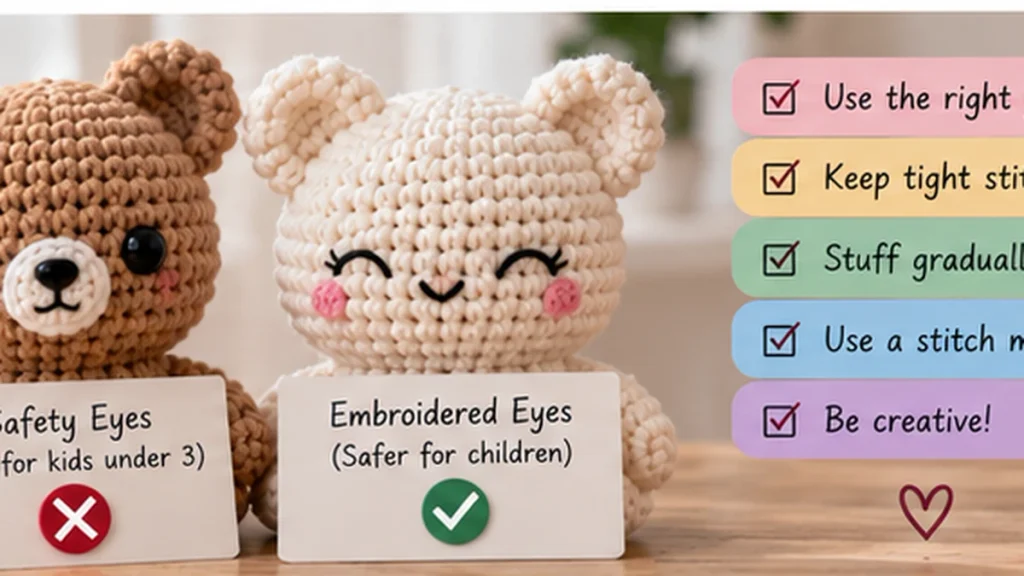
Those shiny plastic eyes can make an amigurumi character adorable, but there’s an important safety consideration.
Don’t use plastic safety eyes for a toy intended for a baby or child under 3.
Lion Brand specifically warns against safety eyes for projects intended for children under three because they can present a choking hazard. Their current amigurumi material guidance similarly recommends embroidered eyes for baby projects.
For young children, embroidered facial features are the safer direction.
7 Tips for Better-Looking Amigurumi
- Use a stitch marker. Mark the beginning of continuous rounds.
- Count your stitches. One missed increase can distort the entire shape.
- Stuff gradually. Add small amounts rather than forcing in a huge clump at once.
- Don’t overstuff. Too much filling can stretch the stitches and expose gaps.
- Pin pieces before sewing. Check that ears, arms and legs are symmetrical.
- Embroider details carefully. Small facial changes have a surprisingly large effect.
- Keep notes when experimenting. If you accidentally create the perfect shape, you’ll want to know how you made it.
Amigurumi FAQ
Is amigurumi difficult for beginners?
Not necessarily. Many simple designs rely mainly on single crochet, increases and decreases. The challenge is usually learning to work in small continuous rounds and maintaining accurate stitch counts.
What is the easiest amigurumi to crochet?
Simple rounded characters with few separate pieces are usually easiest. Small no-sew designs can also reduce the amount of assembly required.
What stitch is most commonly used for amigurumi?
Single crochet is fundamental to many amigurumi designs. The Craft Yarn Council abbreviation for single crochet in U.S. terminology is sc.
Do I need a magic ring?
Not always. It’s a very useful technique because it creates an adjustable center, but a two-chain starting method can be used as an alternative for some projects.
What can I use instead of safety eyes?
You can embroider the eyes using yarn or embroidery thread. This is particularly important when making toys for very young children.
Can I sell amigurumi I make from someone else’s pattern?
Check the specific pattern’s license and terms. Don’t assume purchasing or downloading a pattern gives you the right to reproduce or redistribute the pattern itself. Some designers permit selling finished items with attribution while restricting redistribution of their instructions; terms vary by designer.
Final Thoughts
The best thing about amigurumi is that a few basic crochet techniques can turn yarn into almost anything you can imagine.
Start with something manageable—perhaps a mini octopus, mushroom, frog or tiny food character—and gradually move toward more detailed animals and original designs.
And in 2026, experimenting is particularly relevant: Pinterest reports searches for unique amigurumi up 56%, alongside broader momentum around tiny, tactile and collectible crafts.
So don’t feel like your next project has to be another traditional teddy bear.
Make it tiny. Make it weird. Make it yours.