
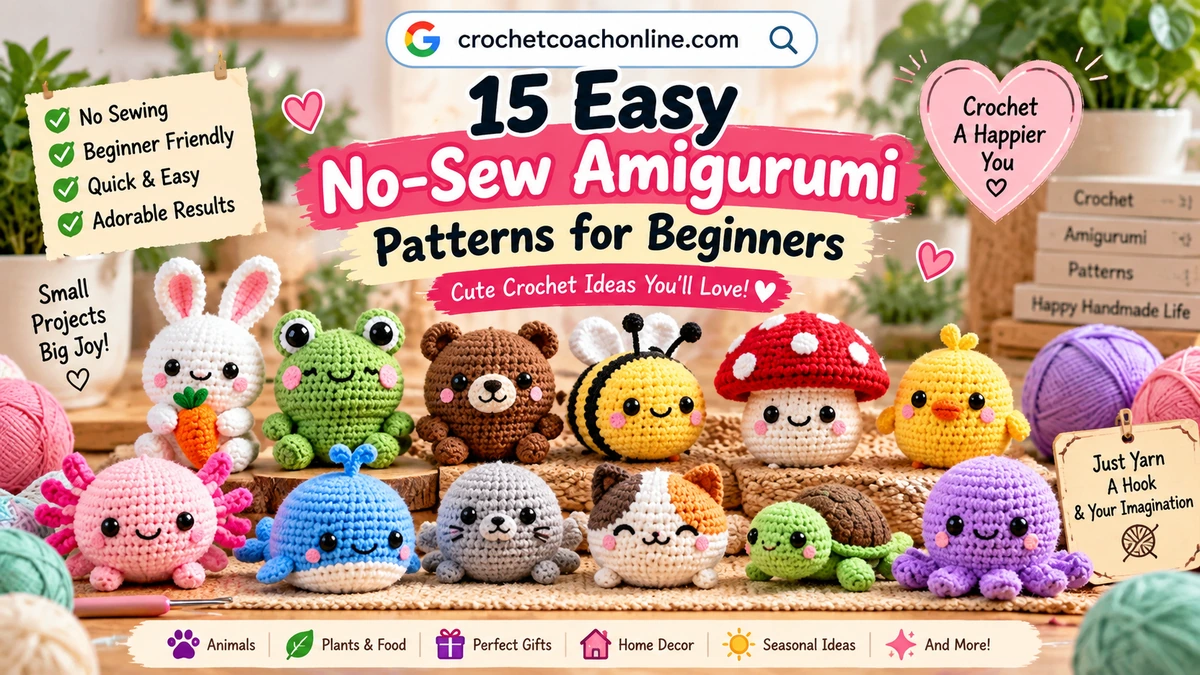
If you love amigurumi but hate sewing tiny arms, legs and ears onto your finished crochet projects, no-sew amigurumi may become your new favorite way to crochet.
Instead of making many separate pieces and assembling them at the end, no-sew amigurumi patterns incorporate most—or sometimes all—of the features while you crochet.
That means less finishing, fewer loose pieces and, in many cases, a much faster project.
In this guide, you’ll discover 15 easy no-sew amigurumi ideas for beginners, from tiny octopuses and frogs to bears, bees and mushrooms.
What Is No-Sew Amigurumi?
Traditional amigurumi often works like this:
Crochet body → crochet arms → crochet legs → crochet ears → sew everything together.
No-sew construction tries to eliminate that final assembly stage.
Depending on the design, ears, legs, wings or other features can be crocheted directly into the main piece as you work.
Some patterns are completely seamless, while others are technically low-sew, requiring only one or two small attachments.
That’s why it’s worth checking the construction notes instead of assuming every pattern labeled “no-sew” is literally made without a needle.
No-sew designs are especially attractive to beginners because assembly and symmetrical placement can be among the fiddliest parts of making amigurumi. Current 2026 beginner guides similarly emphasize continuous construction and reduced finishing as the main advantages.
What You Need to Know First
You don’t need dozens of crochet stitches.
For many simple projects, the most important techniques are:
| Abbreviation | Meaning |
|---|---|
| MR | Magic Ring |
| sc | Single Crochet |
| inc | Increase |
| dec | Decrease |
| ch | Chain |
| sl st | Slip Stitch |
| st | Stitch |
The Craft Yarn Council maintains the standardized U.S. crochet terminology used by designers and publishers, including ch, sl st, sc and other common abbreviations.
Craft Yarn Council Crochet Abbreviations
Now for the fun part.
1. No-Sew Mini Octopus
A tiny octopus is one of the first designs I’d consider for someone new to no-sew amigurumi.
The naturally rounded body keeps shaping relatively simple, while the tentacles can be incorporated around the bottom rather than made as eight separate pieces.
Best for: First no-sew project
Difficulty: Easy
Great yarn choice: Smooth acrylic or cotton
Once you’re comfortable, try making several in different colors to create a tiny ocean collection.
No-sew octopus designs are also actively available in current crochet communities, including free versions with accompanying tutorials.
2. No-Sew Chubby Frog
A round frog gives you a lot of personality without requiring complicated anatomy.
Use a bright green body, rounded eye bumps and a tiny embroidered smile.
More experienced beginners can add:
- Pink cheeks
- A miniature flower
- A crown
- A mushroom hat
- A tiny scarf
No-sew chubby frog designs are currently among the free amigurumi patterns being shared by established Ribblr designers.
Best for: Cute character lovers
Difficulty: Easy–Advanced Beginner
3. Mini No-Sew Bear
A little round bear is another excellent beginner project.
Keep the body compact and integrate the ears and limbs as you work.
Brown is the obvious choice, but cream, white, caramel or pastel yarn can completely change the character.
Mini no-sew bears are currently offered as beginner patterns on Ribblr, where one free design has been saved by more than 1,000 crafters.
Best for: Beginners who want a recognizable animal
Difficulty: Beginner
4. No-Sew Bee
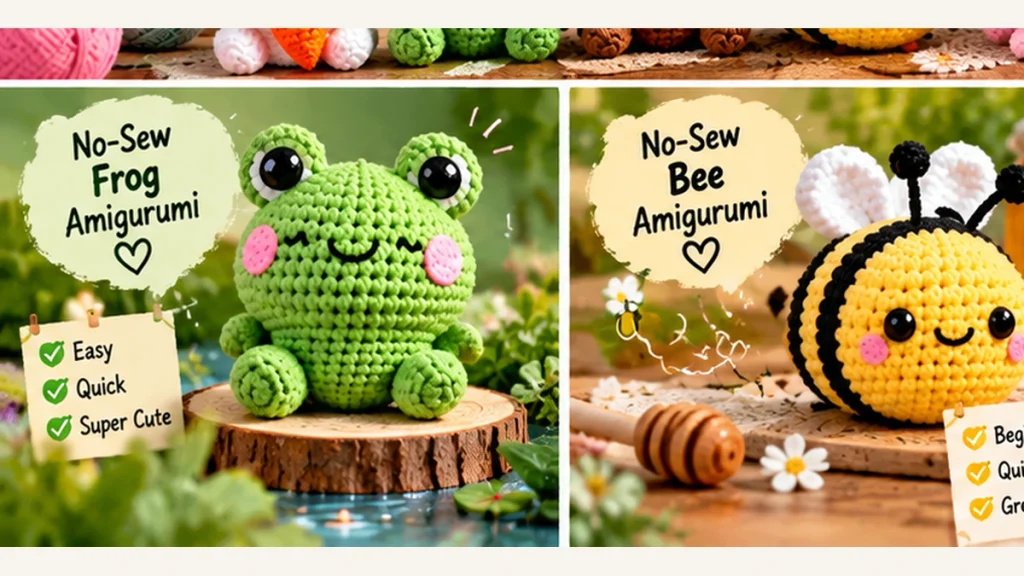
A crochet bee works particularly well as a small project because its body is based on a simple rounded shape.
Alternate yellow and black yarn for the stripes.
The wings can be incorporated directly into some constructions instead of being sewn on afterward.
A tiny bee is also useful for practicing color changes before attempting more complicated amigurumi.
Current beginner no-sew bee patterns use familiar techniques such as single crochet, magic ring, decreases and color changes.
Best for: Practicing color changes
Difficulty: Beginner–Advanced Beginner
5. No-Sew Mushroom
Mushrooms are perfect when you want something cute without needing realistic animal proportions.
Try:
Red + cream for a classic woodland mushroom.
Or experiment with:
Pink + white
Lavender + cream
Brown + beige
Add tiny embroidered spots rather than attaching lots of separate pieces.
Best for: Cottagecore crochet
Difficulty: Beginner
6. No-Sew Baby Chick
A small yellow chick can be built around an almost spherical body.
The simple silhouette makes it particularly forgiving.
A tiny orange beak and black embroidered eyes are enough to make the character recognizable.
Current beginner crochet communities frequently recommend chicks and ducks when people specifically ask for quick, easy plushies.
Best for: Spring and Easter projects
Difficulty: Beginner
7. No-Sew Mini Whale
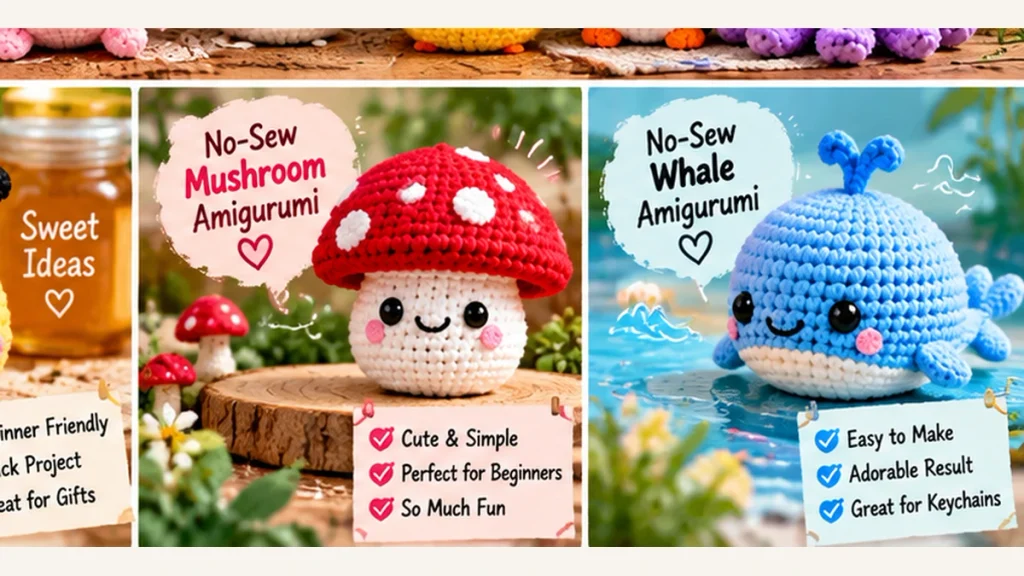
The whale is another excellent shape for continuous construction.
Start with a rounded body and gradually taper toward the tail.
Try:
- Pastel blue
- Gray
- White
- Lavender
- Pink
You can also embroider a tiny smile.
Best for: Ocean-themed collections
Difficulty: Easy
8. No-Sew Bunny
A bunny can be slightly more challenging because the ears need to look balanced.
But a simplified chubby version can still work beautifully as a low-sew or no-sew project.
Use a compact body and long ears to create the recognizable silhouette.
Add a small embroidered nose and eyes.
Best for: Gifts and spring projects
Difficulty: Advanced Beginner
9. No-Sew Mini Penguin
Think:
Black body + white belly + tiny orange beak.
A rounded penguin doesn’t need complicated shaping.
For an even cuter version, add a tiny scarf or winter hat—but those extras may turn the project from completely no-sew into low-sew.
Best for: Winter crochet
Difficulty: Easy
10. No-Sew Ghost
This is one of the simplest seasonal concepts.
A rounded white body, gently shaped bottom and embroidered face can produce a recognizable ghost without complicated limbs.
It’s also timely: a no-sew beginner ghost pattern published in September 2026 describes a one-piece project designed to be completed in about 90 minutes.
Best for: Halloween
Difficulty: Beginner
11. No-Sew Mini Seal
A seal’s smooth, rounded silhouette makes it ideal for minimal-sewing construction.
You don’t need four large legs or complicated ears.
Focus instead on:
- Rounded head
- Tapered body
- Small flippers
- Tiny face
Almost-no-sew baby seal designs are already represented among current free crochet pattern collections.
Best for: Beginners moving beyond basic spheres
Difficulty: Easy–Advanced Beginner
12. No-Sew Loaf Cat
Imagine a cat shaped almost like a loaf of bread.
That’s precisely why this style works so well.
Instead of worrying about realistic legs and body proportions, you can focus on the rounded body, little ears and expressive face.
Current crochet pattern collections include almost-no-sew loaf-cat designs, showing that this simplified construction is already established among makers.
Best for: Cat lovers
Difficulty: Advanced Beginner
13. No-Sew Mini Duck
Like the baby chick, a duck works well with a simple rounded construction.
Use:
Yellow body + orange beak
or make a mallard-inspired version when you’re ready for additional color changes.
No-sew duck designs are also represented in current pattern collections.
Best for: Quick animal projects
Difficulty: Beginner
14. No-Sew Crochet Fruit
Not every amigurumi project needs to be an animal.
Try making:
- Strawberry
- Peach
- Orange
- Lemon
- Blueberry
These are excellent projects for learning shaping because the basic body can remain simple.
Current amigurumi collections include free little orange and peach designs alongside animal plushies.
Best for: Very small projects and keychains
Difficulty: Beginner
15. No-Sew Mini Turtle
Finish the list with a tiny turtle.
The shell provides a great opportunity to experiment with contrasting colors.
Try:
Sage + cream
Pink + beige
Blue + white
Depending on the construction, a turtle may require slightly more shaping than a bee or octopus, so I’d save this one until you’ve completed one or two simpler projects.
Best for: Your second or third no-sew project
Difficulty: Advanced Beginner
Which No-Sew Amigurumi Should You Make First?
If you’re completely new, I’d start with:
Mini Octopus → Bear → Bee → Chick → Ghost
These designs rely heavily on rounded shapes and avoid complicated proportions.
Then move to:
Frog → Whale → Penguin → Seal
And finally:
Bunny → Loaf Cat → Turtle
The exact difficulty will always depend on the specific pattern.
Best Yarn for No-Sew Amigurumi
For your first project, smooth yarn has one major advantage:
You can actually see your stitches.
A medium-weight cotton or acrylic yarn is therefore a sensible starting point.
After you’ve learned to identify stitches confidently, try chenille or plush yarn for a softer, chunkier result.
The important thing is to use a hook that creates sufficiently dense fabric so that the stuffing isn’t clearly visible between stitches.
Why Are No-Sew Patterns So Popular?
Speed is only part of it.
Traditional amigurumi can leave you with a beautiful body followed by a pile of ears, arms and legs that still need careful positioning.
No-sew construction removes or reduces that stage.
Current crochet communities specifically ask for quick, free and cute no-sew patterns for situations such as preparing handmade items efficiently, while recent 2026 pattern roundups emphasize reduced finishing and fewer loose pieces.
For beginners, that means more time learning:
tension → stitch counting → increases → decreases → shaping
and less time worrying about whether two ears have been sewn at different heights.
7 Tips for Better No-Sew Amigurumi
1. Always use a stitch marker. Continuous rounds are very easy to lose track of.
2. Count every shaping round. A missing increase early in the project can distort later rounds.
3. Stuff gradually. Small amounts usually produce a smoother shape.
4. Don’t overstuff. Overstuffing can stretch the fabric and reveal gaps.
5. Keep your tension consistent. This helps create an even surface.
6. Learn the invisible decrease. It can create a cleaner-looking decrease on amigurumi.
7. Read the whole pattern before starting. This matters especially with no-sew construction because a limb or ear may need to be incorporated during a specific round.
No-Sew vs. Low-Sew Amigurumi
They’re not necessarily the same.
No-sew: The design requires no separate pieces to be sewn onto the main body.
Low-sew: Most construction is integrated, but one or two pieces still need attachment.
Don’t reject a good project simply because it requires two minutes with a yarn needle.
For many beginners, low-sew is still dramatically easier than traditional multi-piece amigurumi.
No-Sew Amigurumi FAQ
Is no-sew amigurumi easier for beginners?
It can be. Removing the final assembly stage means beginners can concentrate on crochet tension, counting and shaping. However, some no-sew designs use bobbles, color changes or special construction techniques, so “no-sew” doesn’t automatically mean “easy.”
What is the easiest no-sew animal to crochet?
A small octopus, bear, bee or chick is a good starting point because the body is based largely on simple rounded shapes.
Do I need a magic ring?
Many amigurumi patterns begin with one because it creates an adjustable center. If you haven’t learned it yet, practice it separately before starting your first project.
Can I make no-sew amigurumi with plush yarn?
Yes. Plush and chenille yarn can create very soft toys, but beginners may find the stitches harder to see than with smooth cotton or acrylic.
How long does no-sew amigurumi take?
It depends heavily on the design, yarn and your experience. Small projects can sometimes be completed in a single sitting; for example, a recent beginner ghost design targets roughly 90 minutes.
Is no-sew amigurumi completely seamless?
Not always. Some designers use “no-sew” for projects with fully integrated construction, while others may still require minor finishing or embroidery. Read the pattern notes before beginning.
Final Thoughts
No-sew amigurumi is a great way to enjoy the character-building side of crochet without spending the end of every project attaching a pile of tiny pieces.
Start simple.
Make an octopus, bear or bee first. Once continuous rounds, increases and decreases feel natural, move into frogs, bunnies, seals and more creative designs.
Soon, the question won’t be whether you can make amigurumi.
It’ll be which tiny character you want to crochet next.